
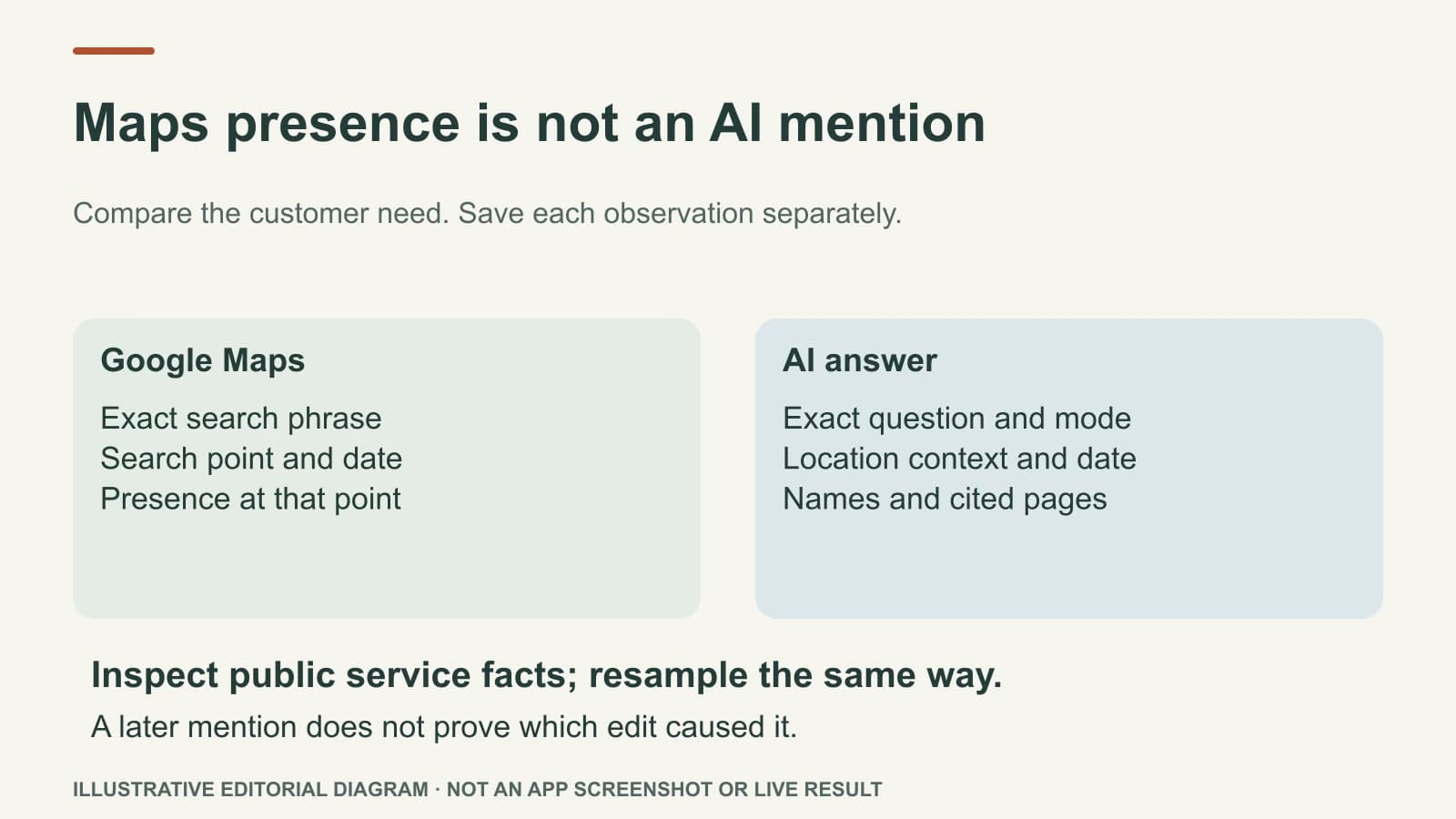
You can appear on Google Maps and be absent from an AI answer because those are different observations. Maps shows local results for a search at a particular place. An AI system responds to a question using its own context and sources; it may name businesses, cite pages, describe the category without naming anyone, or answer differently later. A Maps listing does not guarantee an AI mention, even when the customer seems to be asking for the same service.
The useful response is a short diagnosis, not a promise to “fix your AI rank.” Compare the same customer need at the same time and place as closely as the products allow, save what each actually showed, check any cited sources and public business facts, then repeat the check later.
Compare the same customer need before guessing why
Suppose Marlow Shoe Repair is a fictional shop in Guelph. Its owner wants to know why it appears in a Maps search for “heel repair near Guelph station” but is absent when someone asks an AI service, “Where can I get a heel repaired near Guelph station?” The two wordings express a similar need, but they are not identical product inputs. Record that difference instead of silently calling them the same query.
For a useful comparison, keep a small record:
| Record | Google Maps | Named AI service |
|---|---|---|
| Customer wording | Exact phrase entered | Exact question submitted |
| Time and context | Date, time, search point, device and language | Date, time, service or mode, language and any location given |
| What appeared | Shop's presence or absence at the sampled point; visible alternatives | Shop named or omitted; exact wording and any cited pages |
| Evidence | Screenshot or saved observation with the point marked | Saved answer or screenshot and the cited URLs shown |
If the AI product does not accept or reveal a precise searcher location, say so. Do not treat a phone's position in Maps as the AI answer's hidden location. A nine-point Maps grid can show how local results vary across places; it is not an AI-answer test.
A worked mismatch, without a made-up diagnosis
Here is a synthetic example, not a Mazuly check or a real search result. On the same morning, a Maps sample near the fictional shop shows Marlow Shoe Repair for the phrase above. One named AI service's answer to the related question does not name Marlow and cites two other local directories. Marlow's own service page says only “repairs for your favourite shoes”; it does not clearly say whether the shop offers heel repair. The owner has confirmed that heel repair is offered by appointment, but that fact is not yet clear on the public page.
What does this prove? Only that the shop appeared in that Maps sample and was omitted from that AI answer. It does not prove the vague service page caused the omission. The AI system may have selected other sources or interpreted the question differently. The directories it cited may simply have more explicit service descriptions; inspect them before drawing any conclusion.
The owner has a sensible factual fix regardless of the AI answer: make the service page name heel repair, explain the appointment route and reflect the shop's actual location and hours. Check that the Google Business Profile and any directory the business can edit agree. Do not create a duplicate “heel repair near every suburb” page or add towns the shop does not serve.
Sort the evidence into an action
| What you observed | First owner check | Avoid claiming |
|---|---|---|
| Maps shows the shop; AI omits it | Does the public service page answer the exact customer need? Which pages did AI cite? | “Maps is broken” or “AI has penalised us.” |
| AI names the shop but states wrong hours or service | Compare the answer with the live website, profile and any source it cites; correct a source you control. | “This one edit will update every model.” |
| AI cites the shop's page but still omits its name | Read the answer and cited passage together; check whether the page identifies the business and service plainly. | “A citation means the business was recommended.” |
| Maps differs by search point | Check the actual service area and the phrase from realistic points. | “We have one permanent citywide rank.” |
Google says local results mainly depend on relevance, distance and popularity, so a Maps result needs a location attached to it. Google's AI search guidance advises useful, reliable, accessible content for its own AI search features. It does not promise that a particular page edit will make a business appear in Google AI, much less in another company's AI service.
Fix a fact, then resample the same way
Write down the fact changed, where it changed and when: for example, “4 October: added confirmed heel-repair scope and appointment link to the shoe-repair page; checked the profile's hours.” Save the original Maps and AI observations. Later, repeat the same phrase and question on the same products with the same recorded location and language context where possible. Note any platform change that makes the comparison imperfect.
If the shop appears next time, report the new observation. Do not say the page edit caused it. If it is still omitted, do not undo accurate customer information simply to chase a model answer. The point of the fix was to help a person understand the real service.
Mazuly keeps these observations separate: Search Visibility samples local Maps presence, while AI Visibility shows supported AI-answer checks. For the general method of choosing AI questions, use how to check AI mentions. When you need to explain observations to an owner or client, use the one-page AI visibility report template. Neither view is a guaranteed ranking or a substitute for a working service and booking route.