
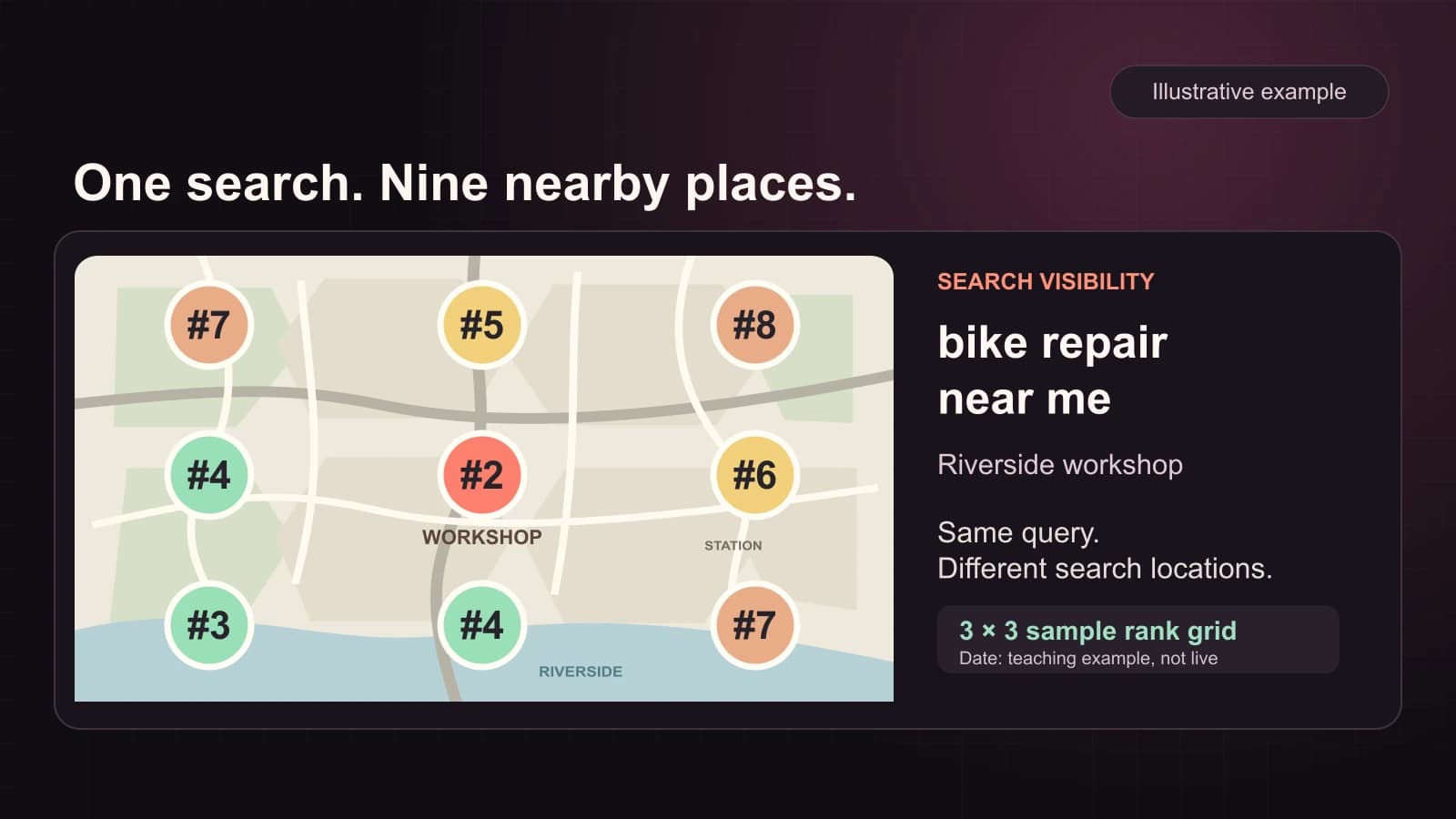
A nine-point Google Maps grid checks the same customer search from nine nearby places. It shows whether a business appears differently across an area, instead of compressing local visibility into one misleading “rank.” It is a sample of locations, query and time—not a promise that every customer will see the same result or that Mazuly can raise the position for you.
If a bicycle workshop is easy to find next to its own street but less visible across the river, that is useful to know. It does not immediately tell the owner to buy an ad, change the business name, or build a page for every street. First, understand what was measured.
Read the grid like a map, not a scorecard
Here is a fictional teaching example, not a real Mazuly or Google result. Imagine a verified bicycle repair shop, one search phrase—“bike repair near me”—and a grid around its Riverside location checked on the same day. Each number below represents an illustrative Maps position at one sample point.
| Northwest | North | Northeast |
|---|---|---|
| #7, residential area | #5, near the bridge | #8, across the river |
| West: #4, shopping street | Centre: #2, near workshop | East: #6, near station |
| Southwest: #3, adjacent area | South: #4, main road | Southeast: #7, industrial edge |
The centre point is one observation. The more useful picture is the pattern: closer points in this example are stronger; northeastern points are weaker. That may reflect distance, competition, relevance for the phrase, or other factors. The grid alone cannot diagnose which cause dominates.
For a real check, the owner should be able to see at least the search phrase, business location, sampled area, date, and each sampled position. Without those labels, two attractive grids cannot be compared responsibly. A change between weeks is worth investigating, but one week's movement is not proof that a particular marketing post caused it.
What the nine points do—and do not—measure
Mazuly Search Visibility checks Google Maps positions from nine points around a location. Its marketing plan describes a weekly grid for up to three customer search prompts per location. That can reveal local differences for the specific prompts chosen. It is not a full technical SEO audit, a count of phone calls, a measurement of all keywords, or a position for the entire city.
Select phrases a real customer might use for a real service. “Bike repair near me” and “bicycle tune-up Riverside” might answer different questions; do not assume one grid represents the other. Keep the phrase, area and sampling method comparable when you check a trend. Record a business change separately: new hours, a moved location, a changed service page, or a competitor opening.
Google explains that local results are mainly shaped by relevance, distance and popularity. Its local ranking guidance also says there is no way to request or pay for a better local ranking. A grid makes variation visible; it does not reveal Google's exact formula or tell you that adding keywords to a business name will fix the pattern.
The question to take to the next check
The grid shows where to investigate, not which edit will improve a position. Record a recurring weak area only if the sampled points are inside the area the business actually serves and the phrase names a real service. Keep the same search phrase, sampled area and sampling method when comparing runs over time, and record each run's actual observation date. If the pattern matters to customers, use the separate 30-minute fact audit after a Maps check to choose and document one useful action. That guide starts after the measurement; it does not redraw this nine-point example.
Do not report “we rank #2 in Google Maps” based on the centre cell of this example. A fair report says: “For this phrase, on this date, the business appeared at these nine sampled points, with stronger visibility near the workshop and weaker visibility across the river.”
Maps visibility is different from AI-answer visibility
The grid samples Google Maps results. AI Visibility asks whether supported AI systems name or cite the business in answers to selected questions. A mention in one AI answer is not a Maps position, and a good Maps cell does not guarantee an AI mention. Owners can use both observations without merging them into one invented “local AI rank.” The guide to checking AI-answer mentions explains that separate measurement.
The useful result of a grid is a more precise question: Where are we easier or harder to find for a service we truly offer? That gives the owner something to investigate without pretending the map is a lever that automatically changes Google's results.