
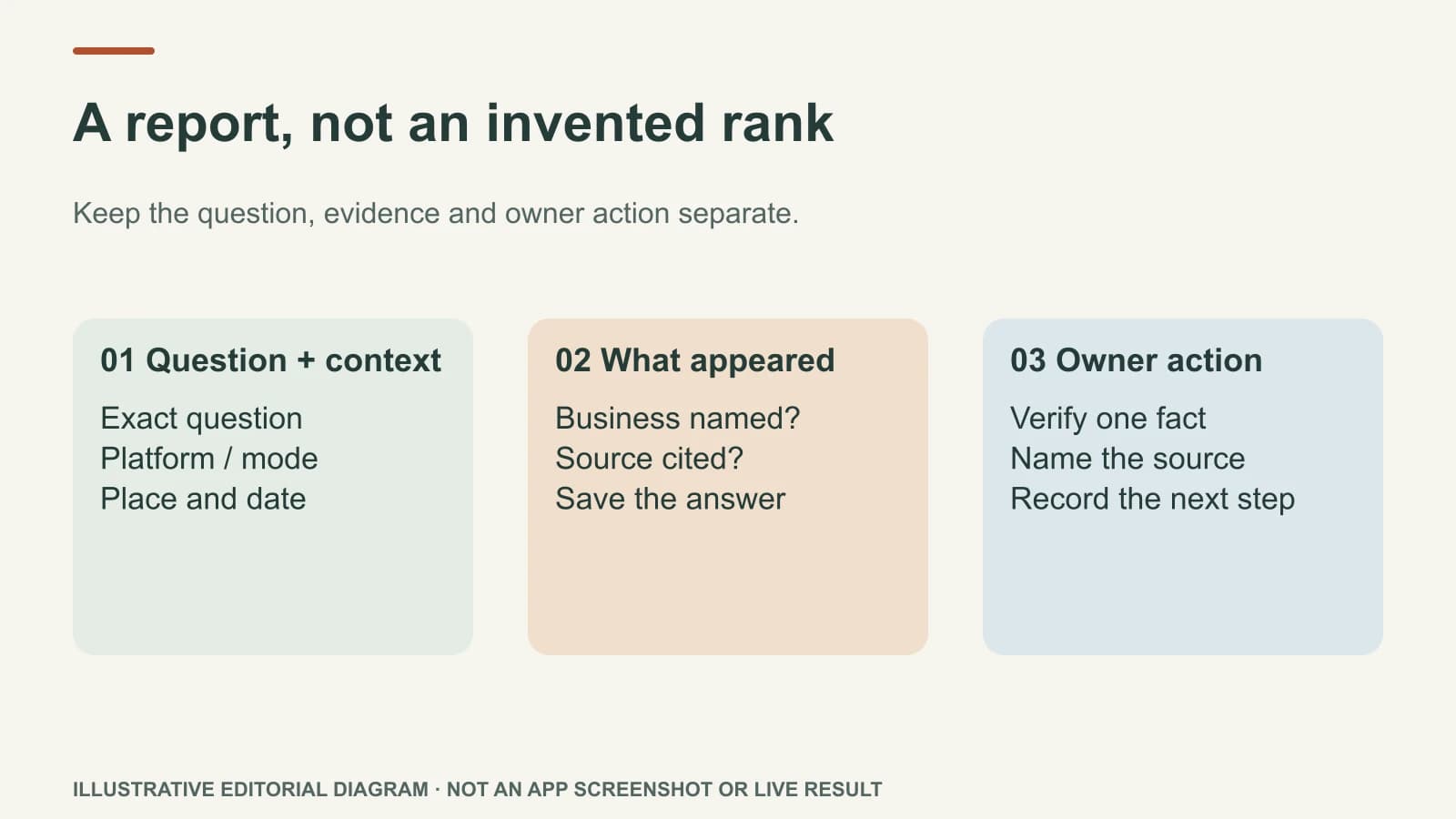
An AI visibility report should let a busy owner answer three questions: What did we check? What did the answers actually show? What useful fact should we check next? It should not turn a handful of prompts into a universal AI ranking or a promised business result.
Copy the one-page summary below and keep its evidence appendix. Use actual customer-style questions, name each platform and mode checked, record the date and location context, and separate a business mention from a visible citation. If nothing is wrong on the public site, the next action can simply be to repeat the same sample later.
Copy this one-page owner report
Replace every bracketed field with observed information. Leave an unknown as “unknown” rather than filling it with a guess.
AI VISIBILITY — OWNER REPORT

Business and location: [name; location or service area]
Reporting period: [dates]
Prepared by: [person]

Customer questions: [number and IDs of unbranded questions; branded checks separate]
Where and how checked: [platform + mode/version if shown; country/area;
  location supplied or unavailable; date/time; signed-in or other relevant context]

What we observed: [For each platform, name the business mentions and omissions
  within this specific question set. Do not combine unlike platforms into one score.]
Visible citations: [Exact page URLs shown, or “none shown”; distinguish a cited
  business page from a third-party page and from a plain link.]
Accuracy check: [Specific statement checked against a dated public source,
  or “no factual concern found in this sample.”]

Owner decision: [One fact to verify or correct; where; who owns it; by when.
  If no correction is warranted, state when the same questions will be checked again.]
Limit: [This small, dated sample is not a fixed AI rank, share of all customer
  questions, traffic estimate, booking count or proof that one edit caused a change.]

Evidence appendix: [Location of the prompt-by-prompt records and saved answers]
The report is short because the evidence lives below it. A reader should be able to trace every sentence in “What we observed” to an exact prompt, answer and date. Do not call a page a citation unless the system actually displayed it as a source; a plain link or a business name is a different observation.
See a filled example before using it
Everything in this example is synthetic. No AI platform was queried and no measured Mazuly outcome is being reported. Meadow Lane Plants is a fictional plant shop in Victoria, British Columbia. For this example, its public page says it sells low-light houseplants and potting mix, offers in-store advice, and provides pickup but not delivery. The example uses placeholder Platform A and Platform B rather than implying that ChatGPT, Perplexity or another real service gave these answers.
AI VISIBILITY — OWNER REPORT (SYNTHETIC EXAMPLE ONLY)

Business and location: Meadow Lane Plants, Victoria, BC (fictional)
Reporting period: Sample morning, 2 October 2026 (no live checks performed)
Prepared by: Example editor

Customer questions: P1 and P2, both unbranded; four example answer records
Where and how checked: Platform A and Platform B (placeholders); Victoria named
  in each question; location setting and model version unknown

What we observed: In the invented records, A names the shop for P1 and omits it
  for P2. B omits it for both. These are four teaching rows, not a visibility rate.
Visible citations: The invented A/P1 answer cites the shop's example product page,
  https://example.com/low-light-plants. No shop-page citation appears in the
  other example rows.
Accuracy check: A/P1 also says “delivery available.” The fictional business's
  example page says pickup only, so the statement would need investigation.

Owner decision: Check the real product and order pages for a clear pickup-only
  statement, then examine any third-party descriptions the shop can correct.
  Recheck the same questions later; do not promise the answer will change.
Limit: Synthetic illustration. A real four-answer sample would still not show
  an AI rank, all customer demand, bookings or the cause of any later change.

Evidence appendix: The four illustrative rows immediately below.
The shop should not rewrite a correct page merely because one invented answer is wrong. In a real report, first verify the public fact, then note exactly where it is unclear or outdated. If no editable source is wrong, say that and keep the observation for comparison.
Keep a prompt-by-prompt evidence appendix
For a real check, save one row per question × platform × time. Keep the exact wording, platform and mode, date/time, country or area, any location supplied, whether the business was named, every cited URL relevant to the claim, a short accurate answer note, and a permitted screenshot or answer link if available. A screenshot is especially useful because an answer can change later.
| ID | Exact customer question | Platform, date and location context | Named? / cited business page? | Short answer note and saved evidence |
|---|---|---|---|---|
| A/P1 | “Where can I buy a low-light houseplant in Victoria?” | Platform A; 2 Oct 2026; Victoria stated; version unknown | Named / example product page cited | Synthetic answer adds “delivery available”; https://example.com/low-light-plants; illustration only, no screenshot exists. |
| A/P2 | “Which plant shops in Victoria can help a beginner choose a houseplant?” | Platform A; 2 Oct 2026; Victoria stated; version unknown | Omitted / no shop-page citation | Synthetic omission; illustration only, no screenshot exists. |
| B/P1 | “Where can I buy a low-light houseplant in Victoria?” | Platform B; 2 Oct 2026; Victoria stated; version unknown | Omitted / no shop-page citation | Synthetic omission; illustration only, no screenshot exists. |
| B/P2 | “Which plant shops in Victoria can help a beginner choose a houseplant?” | Platform B; 2 Oct 2026; Victoria stated; version unknown | Omitted / no shop-page citation | Synthetic omission; illustration only, no screenshot exists. |
In a real appendix, replace both placeholder platforms with the actual named services, add exact check times and the saved answer locations, and list relevant third-party citation URLs rather than writing “none” when sources were shown. Keep branded questions in a separate group; asking a system to describe the business by name is not the same as testing discovery by a new customer.
Interpret counts without making a ranking claim
Bing Webmaster Tools' official AI Performance announcement explains that its supported Microsoft AI experiences report citations and grounding queries, but those counts do not indicate ranking, authority or placement in an answer. A manual prompt log like this template is narrower still. It reports only the answers sampled, under the recorded conditions. Do not add results from different platforms into one “AI share of voice” percentage without a defensible method and denominator.
Google's guidance for its AI search features points owners back to useful, reliable, accessible information. It is guidance for Google's products, not a rule for every model. A before-and-after report may show that an answer changed; it cannot, by itself, prove that a site edit caused the change.
Mazuly AI Visibility can provide observations for its supported checks. The question-selection guide helps you choose prompts before filling this report; the Maps-versus-AI diagnostic helps when an owner sees conflicting surfaces. Keep the final owner action as concrete as “verify the pickup wording on this page,” not “improve GEO.”