
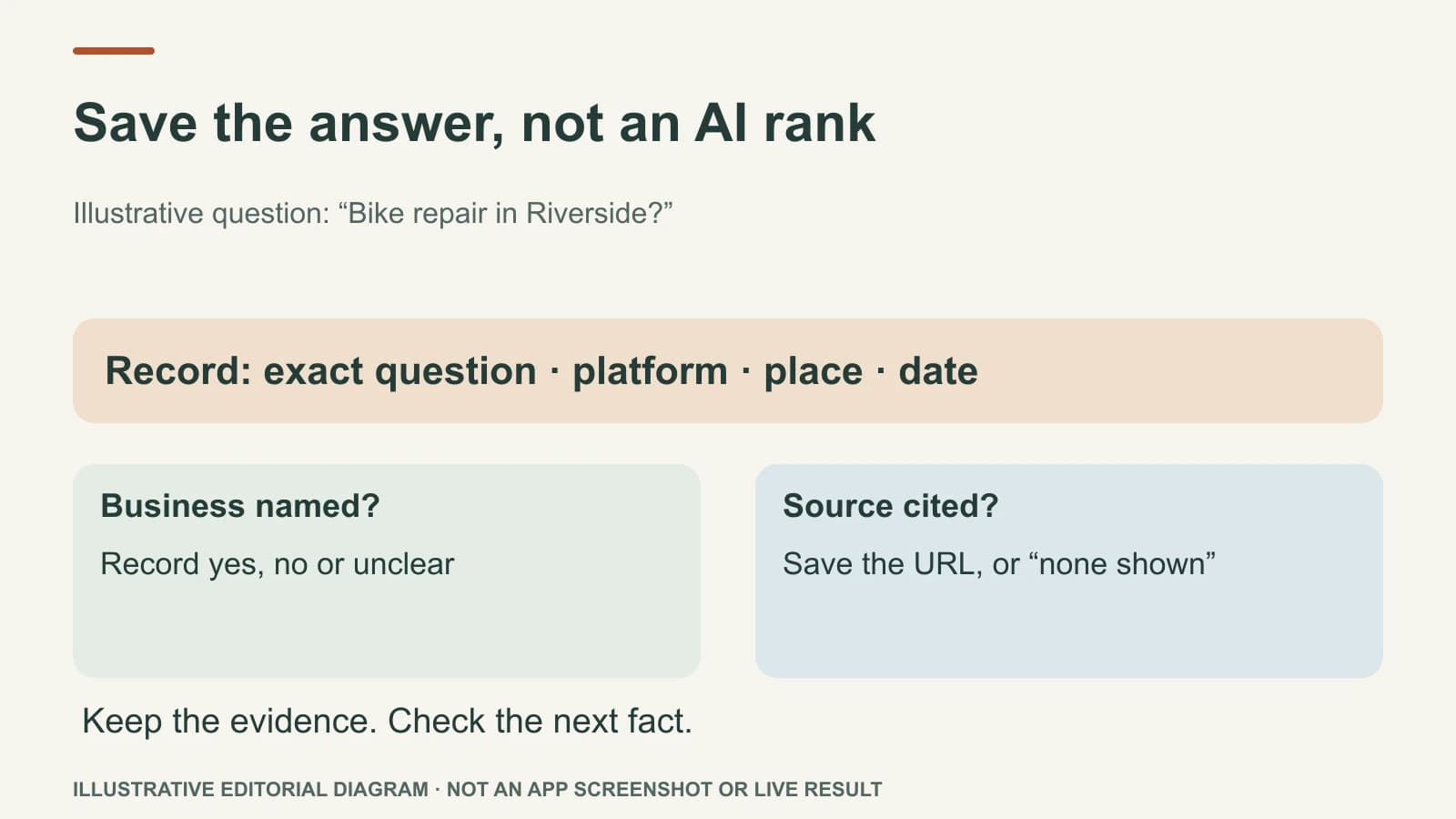
To check whether AI answers mention your business, ask realistic customer questions on the supported platforms, then record the exact question, platform, location context and date. Note whether the answer names the business, links to one of its pages, or does neither. Repeat comparable checks over time. Do not turn one answer into a claim that the business “ranks #1 in AI.”
This is an observation exercise. AI answers can vary with wording, location context, available sources and time. A business may appear for “bike repairs in Riverside” and not for “where can I fix my commuter bike near the station?” That difference is more useful than a single headline score.
Start with the customer's question, not your brand name
Imagine a bicycle workshop that wants to know whether new customers might discover it. Asking “Tell me about Riverside Cycle Workshop” mainly tests whether the system can describe a name you supplied. A more meaningful discovery question is “Where can I get a commuter bike repaired in Riverside?” The owner might also test “Which local bike shops offer booked tune-ups near the station?” Only use the second phrasing if the shop genuinely offers booked tune-ups.
Choose a small set of questions from real customer language:
- a category question: “Where can I get a bicycle repaired near Riverside?”
- a service question: “Who offers a booked commuter-bike tune-up near the station?”
- a choice question: “What should I check before choosing a local bike repair shop?”
Keep a branded question in a separate column if you want to test accuracy about the business itself. Do not mix it into a discovery share-of-voice claim. Also avoid leading prompts such as “Why is our shop the best?” They test your wording as much as the system's knowledge.
Use a small observation sheet
The following is a blank working template, not claimed results. One row represents one question on one platform at one time. Write down the original wording; “bike repair” and “bike tune-up” are not interchangeable if the business serves one more clearly.
| Record | What to capture | Example of a precise entry |
|---|---|---|
| Question | Exact customer-style wording | “Where can I get a bike repaired in Riverside?” |
| Platform | System or search feature tested | ChatGPT, Perplexity, Google AI Overview, Google AI Mode, or Gemini if available in that check |
| Context | Country, town and any location supplied | “Canada; Riverside named in the question” |
| Date and time | When the answer was observed | “8 October 2026, 10:00 a.m. local” |
| Brand named? | Yes, no, or unclear | “No” |
| Business page linked? | Exact URL if a link was supplied; otherwise “none shown” | “none shown” |
| Answer evidence | Short, accurate note or saved permitted record | “Suggested two other shops; no statement about ours” |
| Follow-up | Factual site or profile issue worth checking | “Check whether our tune-up service page names the Riverside location” |
The sample entry in the third column only illustrates how to write a record. It is not an actual scan or a claim about any business. Some AI answers provide links and some do not; “named” and “linked” should be separate fields. Do not call a linked page a citation if the platform did not present it that way.
Compare like with like
Use the same prompt on the same platform when you look for a change, and keep the location context consistent. Save the date. If a platform has no answer for one query, record that rather than replacing it silently with a more favourable question. A monthly sample gives a more honest directional view than repeatedly asking until the business appears.
Do not add the counts across platforms as if they were one universal audience. A mention in one Perplexity answer, a link in a Google AI Overview, and an omission in ChatGPT are three different observations. Neither the tool nor the owner knows how many local customers saw those exact answers. The absence of a mention on one day is also not proof that the business is invisible to every AI user.
Mazuly AI Visibility brings supported AI-answer checks into one view. Check the current product page for supported platforms and plan allowances, which may change. An allowance is not a guarantee of mentions or a reason to repeat slight variations of the same question. Choose prompts that reflect distinct customer decisions.
What to do with a missing or inaccurate mention
First, check the business's own public facts. Can a stranger find a clear service page with the actual location, service area, opening hours, booking route, and evidence of the work? Are the website and Google Business Profile consistent? If the AI answer states something inaccurate, record the claim and look for the public source that may have supplied it. Correct the source where you have control rather than writing a blog post that merely repeats the brand name.
Then improve the answer for people. A service page that says “quality solutions for every lifestyle” gives a visitor little to act on. A page that says what a tune-up includes, who it serves, where the workshop is, and how to book gives a person—and potentially search systems—specific information. The website-clarity guide walks through that work.
Google's guidance for generative search points back to foundational SEO and unique, reliable content. It does not prescribe a special schema or page format that guarantees inclusion. That guidance concerns Google's own AI search features; it should not be presented as a rule governing every other AI platform.
Keep Maps and AI checks separate
A nine-point Google Maps grid samples where a business appears in Maps for a phrase across nearby places. An AI-answer check samples whether an answer names or links to the business for a question. The methods and outcomes are different. A strong Maps sample does not ensure an AI mention, and an AI mention is not a Maps ranking.
The best report to an owner is modest and useful: These are the questions we checked, these are the answers we observed, and these are the public facts we can improve. That is enough to guide the next action without pretending that AI systems share one fixed leaderboard.