
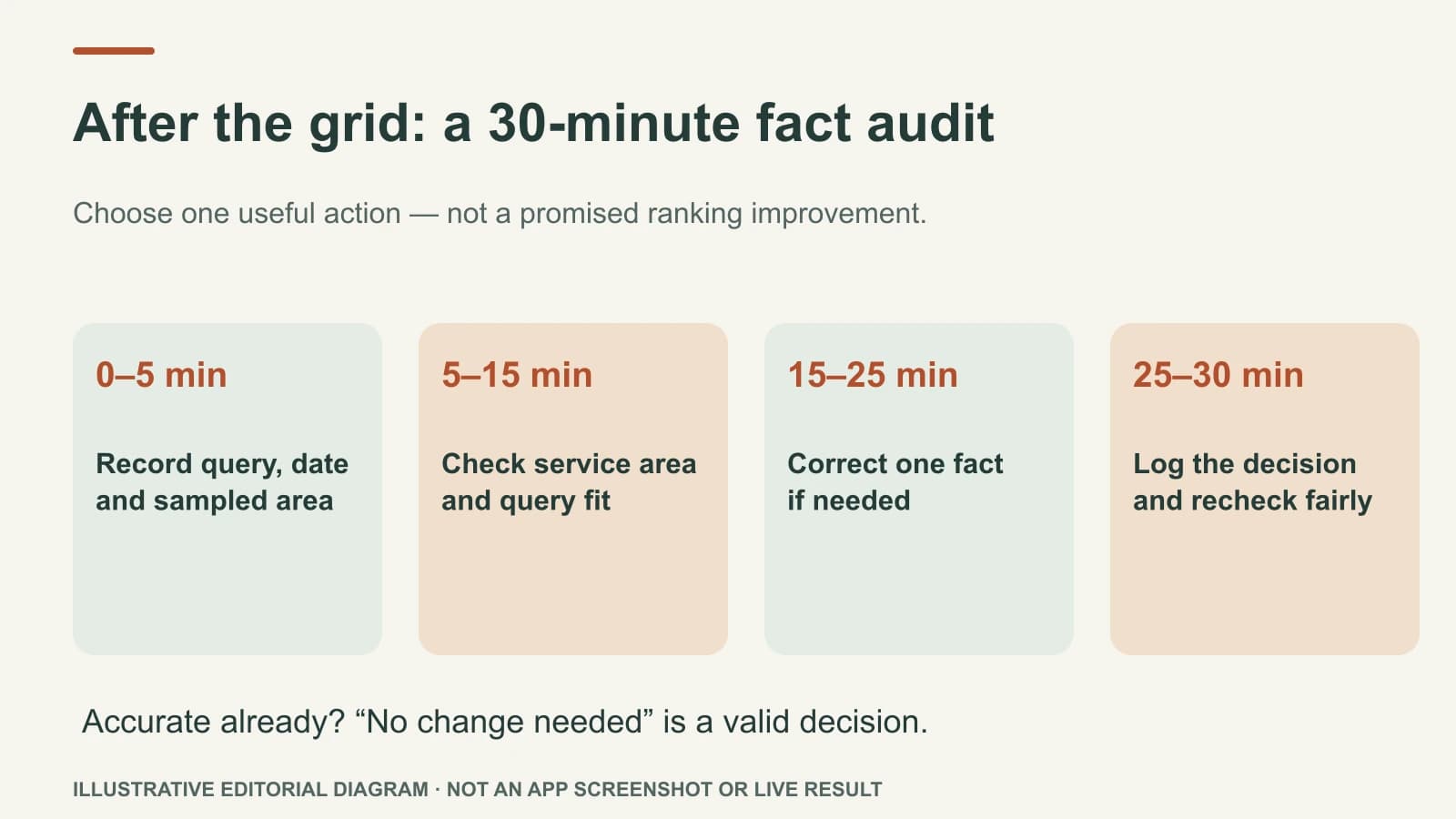
A local Maps check gives you an observation, not a list of fixes. Spend the next 30 minutes checking whether the search phrase, served area, Business Profile and matching service page tell the same true story. Record one correction that would help a customer even if the next Maps position does not move. If you first need to understand the numbers, start with the nine-point grid explainer; this guide begins after you have a dated result.
Minutes 0–5: write down the decision, not another score
Imagine a kitchen-door repair business seeing weaker visibility east of its workshop for “kitchen door repair.” This is an illustrative scenario, not a measured Mazuly customer result. The owner should record the query, check date, grid centre, sampled area and whether the east-side points are places they actually serve. One low cell is not a reason to change the business name or rewrite the website.
Put the question in owner language: “If a customer east of the shop needs this repair, what information would they need to decide whether to contact us?” This separates a customer problem from a ranking observation.
Google says local results are mainly shaped by relevance, distance, and popularity; there is no way to request or pay for a better local rank. The audit below checks facts the owner controls, not Google's algorithm. Google Business Profile's local ranking guidance.
Minutes 5–15: check the search against the real business
Ask: “Would we want a customer who typed this to call us?” The kitchen-door repair shop should not chase “kitchen remodeler” if it does not renovate entire kitchens. A beauty studio should not add a distant suburb to its service claims just because a sampled cell looked weak there.
Write down the actual service, the real area served, and the public page that explains it. If the query is too broad or wrong, choose a better customer phrase for the next check; do not pretend the old result measures the new phrase. If the query fits but an area is outside the business's reach, record that boundary rather than advertising service there.
Minutes 15–25: choose one customer-facing correction
Use a short fact audit rather than a generic “improve SEO” task:
| Check | Evidence to inspect | Useful action if the fact is wrong or missing |
|---|---|---|
| Business Profile | Actual address or service area, category, hours, phone, website link and current service list | Correct the public fact using Google's business-information guidance; do not add a service or area solely to match the query. |
| Matching service page | Does a new customer see the exact service, real area served, examples of the work and a working enquiry route? | Clarify the missing fact or contact route on that page. For the repair shop, “kitchen door repair” needs its own truthful explanation, not a false full-renovation claim. |
| Reviews and other public references | Do recent replies or directory pages contradict the current business facts? | Correct what the owner controls and answer reviews under the owner's chosen settings. Do not promise that a reply will change a Maps position. |
Choose the fix that is both true and helpful. For the illustrative repair shop, a clear service page and current examples of real work may be better than rewriting the homepage around a broad search phrase. If the facts are already accurate, the useful decision may be to make no change and keep observing.
Minutes 25–30: leave a record someone else can follow
Set a reminder to compare the same phrase, area, and grid later. Keep the earlier dated result; changing the grid centre or query makes a before-and-after claim unreliable. A change in the next sample might reflect competition, user location, data updates, or ordinary variation. It does not prove that the last profile edit caused it.
A simple observation log can be enough:
| Date and search | Pattern noticed | Fact checked | Owner action | Next check |
|---|---|---|---|---|
| 4 October; “kitchen door repair” | Strong near workshop, weaker east | Repair page lacked service area | Added the actual areas served and a real job example | Same query and grid in four weeks |
This row is illustrative. It shows a decision record, not a promise of higher positions.
Mazuly's Search Visibility shows a nine-point Maps sample so an owner can see where a search appears to have stronger or weaker coverage. Use it alongside the weekly Google Business Profile check. If the question is about ordinary website search or AI answers rather than the local map, the local search and AI answer guide explains those different measurements.