
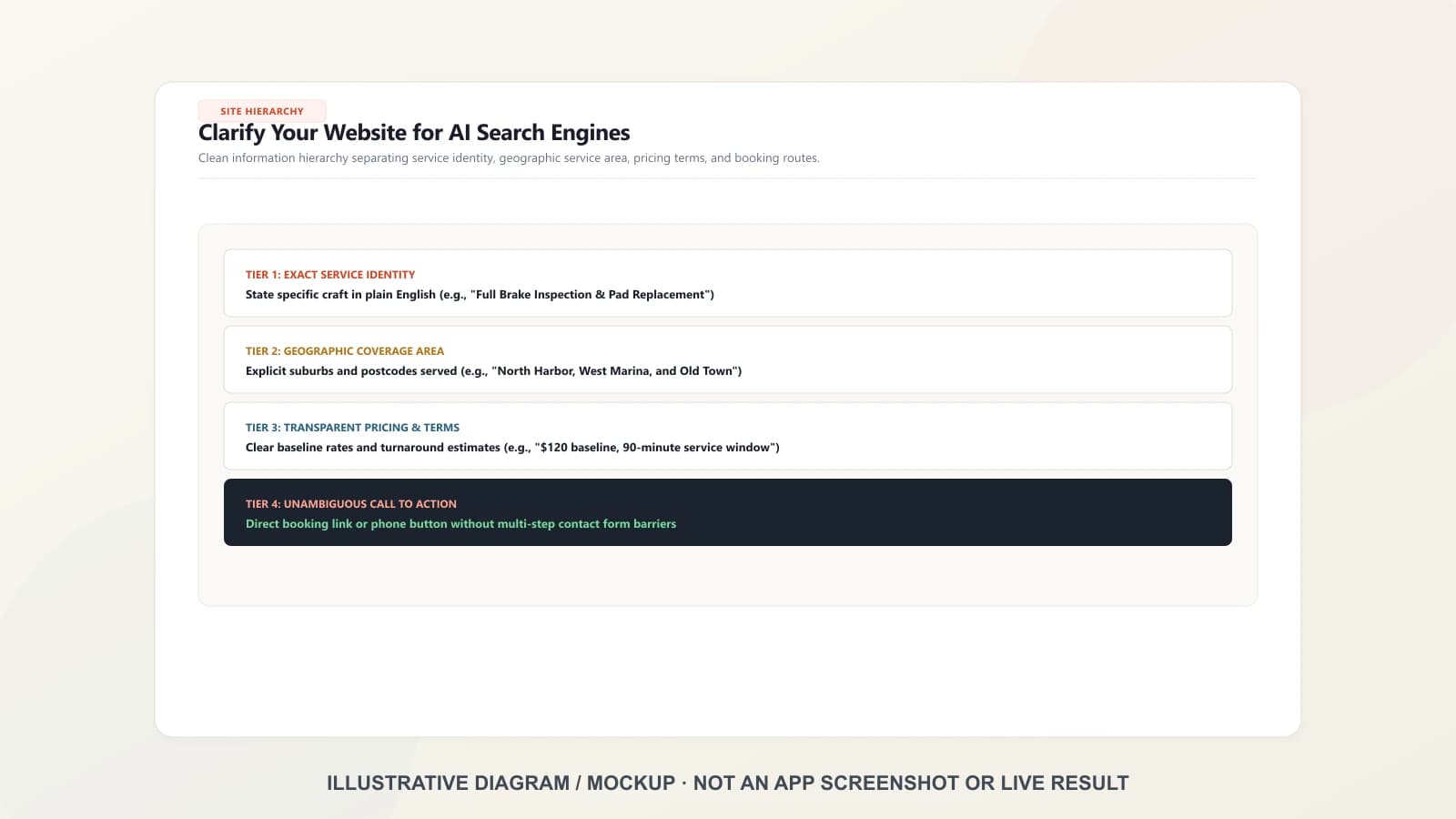
Make your website clear enough that a stranger can answer what you do, where you do it, who it is for, and how to take the next step. Put those facts in readable page text, support them with real evidence, keep them current, and link related pages together. Those changes can help customers and search systems understand the business. They do not guarantee that an AI answer will name it.
Google's guidance for its generative search features recommends foundational SEO and unique, valuable content. It says there is no special AI-search schema or required “AI-friendly” writing format. The goal is a better website, not a parallel set of thin pages written only for a model.
Test one page with an owner's question
Open a service page on your phone and pretend you have never heard of the business. Can you find the exact service, area served, what happens, any conditions or limits, and the booking or enquiry route without guessing? If not, the page has a clarity problem regardless of where it ranks.
Consider this illustrative first paragraph for a landscaping company:
“We deliver premium outdoor solutions tailored to your lifestyle. Our passionate team transforms spaces with quality and care.”
It could belong to almost any company. It does not say whether the team designs gardens, installs patios, maintains lawns, or works in the customer's town. Now compare a more useful draft, assuming every stated fact is true:
“Oakline Landscapes plans and installs small residential gardens in Riverside and the nearby eastern suburbs. We visit the space, discuss how you use it, then prepare a planting and layout proposal. Tell us your postcode and what you want to change to request an initial conversation.”
The second version is not a search trick. It answers a real customer's first questions. If the company also maintains gardens, give that service its own clear explanation rather than adding it as an unsupported afterthought.
The five-part service-page check
| What a reader needs | What to put on the page | What to avoid |
|---|---|---|
| A clear subject | A descriptive title and main heading naming the actual service | “Solutions” as the only service label |
| Location truth | The real business address or service area and any travel conditions | Thirty town pages made by changing only a place name |
| Service detail | What is included, who it suits, what happens next, and genuine limits | A list of every possible keyword or invented turnaround promises |
| Proof | Original job photos with permission, a named process, or verifiable credentials | Stock-looking “before/after” images that imply someone else's work |
| Next action | A visible call, booking or enquiry route that works on mobile | A button that says “Learn more” but leads nowhere useful |
If the page is for one location of a multi-location business, show the facts for that location. A different branch may have different hours, staff, service boundaries or booking details. Repeating one generic city paragraph across every location makes the site harder to trust and easier to misread.
Make important information readable and connected
A photograph can show the finished garden, but it cannot replace a written explanation of the service, area and next step. Put the core facts in accessible page text. Give informative images descriptive alt text; if an image is purely decorative, it does not need a keyword-filled description. Link from the service page to relevant examples or an FAQ, and back from those pages to the service. Google's SEO Starter Guide explains the basics of useful page structure and discoverability; its link guidance explains why ordinary descriptive links matter.
Check that the website can be reached without a login and that the important page is not accidentally hidden from search. A sitemap can help discovery, but it is not a substitute for navigation and contextual links. If the page's title or description changes, read the rendered result rather than assuming a CMS field reached search engines exactly as entered.
Keep the public facts aligned
For a local business, the website and Business Profile should agree on core facts. Google says complete and accurate profile information helps it understand the business, and describes local ranking mainly through relevance, distance and popularity. That is not a promise that changing one page will change a Maps position. It is a reason to remove contradictions customers can already see. Google's local ranking guidance is the primary reference.
Set a simple maintenance trigger: when hours, services, prices, staff, location, or availability change, update the public pages and the saved business details that your marketing tools use. Brand Brain gives Mazuly context for new work, but it cannot correct a stale source page without a real update from the business. If a marketing campaign starts from a public service URL, that URL deserves a factual check first.
Measure an AI answer honestly
After improving the page, ask a few neutral customer questions and record the platform, date, location context, whether the business was named, and whether a page was linked. The AI-answer observation guide provides a repeatable sheet. An omission does not prove the website failed; a mention does not prove your edit caused it. AI systems differ, and their answers can change.
Avoid adding a section headed “For AI crawlers” that repeats your keywords or publishing dozens of interchangeable question pages. Google's current guidance explicitly warns against changing content solely for generative systems. A customer who reaches the page should be better informed than before; that is the most useful standard for the edit.
A one-hour first pass
Choose one important service page. In fifteen minutes, mark every sentence that could describe any competitor. In the next twenty, replace vague claims with verified service, area, process and next-step facts. Use ten minutes to add a real example or photo you are allowed to show. Use the final fifteen to test the page on a phone, check the enquiry route, and link it from a relevant page. Then revisit it when the business changes.
That one page will not solve every visibility question. It will give customers—and any system that reads the page—something concrete to understand.