
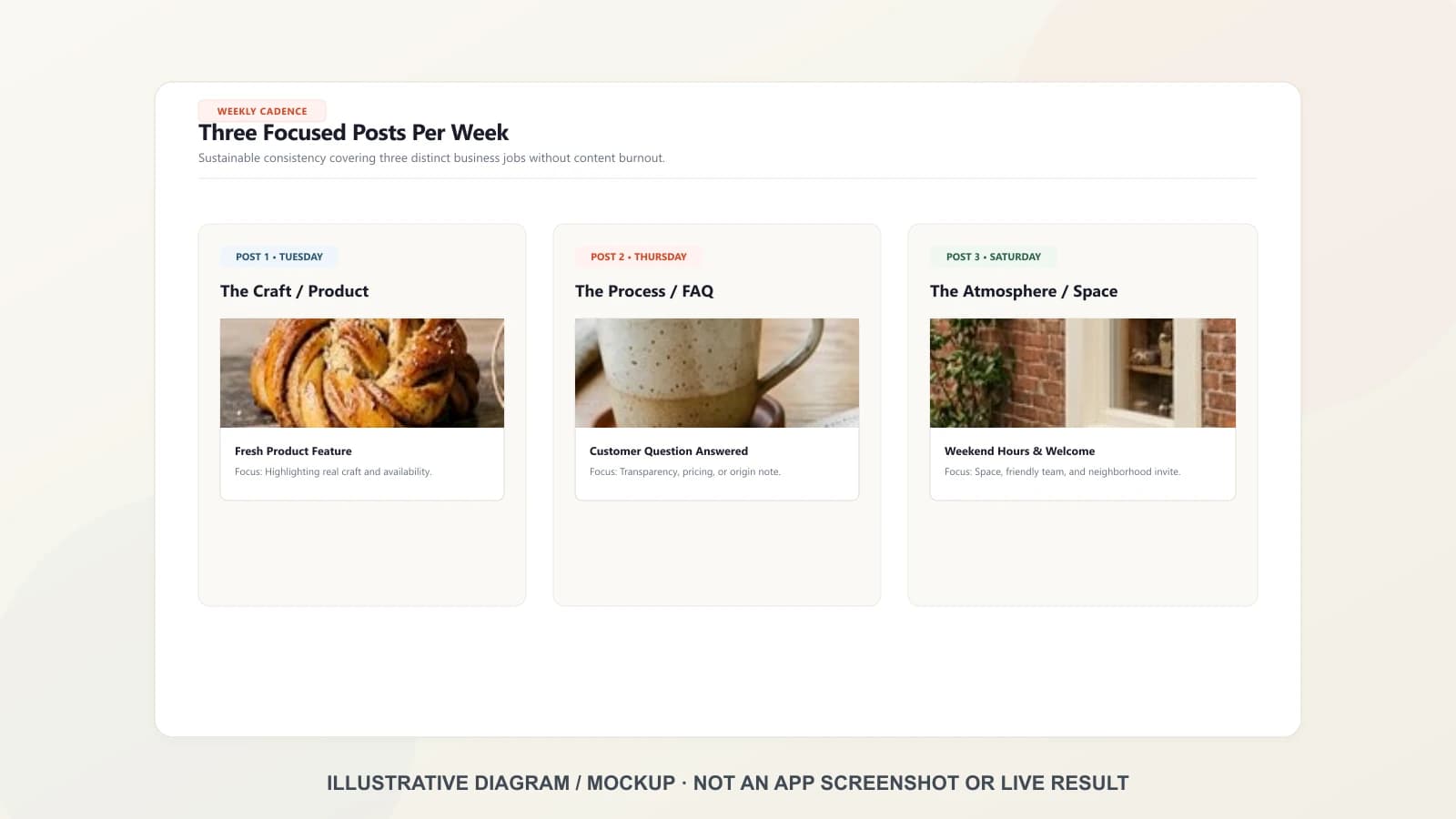
Yes, three useful posts a week can be enough for a small business with three real things to say and the time to keep those posts accurate. It is not a platform rule or a guaranteed growth formula. If you have one strong customer question and one real photo this week, two honest posts may be better than a third generic graphic. If you have a genuine event or opening, an extra timely post may make sense.
The question is not “How do we fill Tuesday, Thursday and Saturday?” It is “What would a customer find useful this week, and can we follow through on the next step?”
Count usable inputs before choosing a number
Look at what actually happened at the business. Three sources often support a good week:
- Proof of real work: a permitted photo of a finished product, service, team member or place.
- A customer question: something staff explained more than once, such as lead time, what is included, or how to prepare for a visit.
- A timely moment: a new service, seasonal item, available appointment, opening-hours change or event.
If those sources are missing, the solution is not to ask AI to invent an occasion. Capture the next real moment, improve a service page, or spend the time replying to customers. Brand Brain can help an assistant understand the business, but it cannot supply a photograph that was never taken or an offer the owner never made.
A three-post week with three different jobs
Consider an illustrative independent bookshop:
| Post job | Real input | What a finished post should say |
|---|---|---|
| Help people choose | Staff photograph of this week's display | Why these books are together and who might enjoy them, without inventing reviews |
| Answer a question | Confirmed ordering policy | How to request a title the shop does not have today |
| Share a timely reason to visit | Verified Saturday author event | Date, time, place, any capacity limit and how to attend |
The first post is evidence, the second is useful service information, and the third asks for an action at the right time. They can be published on different days rather than as three tiles lined up in the same columns every week. The event post must change if the author cancels or capacity is reached.
Each post needs more than a topic label. The image must belong to the shop or be properly licensed, any on-image line must remain readable, and the caption must give the customer a true next step. A post called “Meet the team” with no real person or story is not made useful by placing it on a calendar.
When to post less—and when to post more
Post less when staff cannot verify the facts, no current image is available, or the channel receives repeated offers but few answers to customer questions. Use the saved effort to improve one genuinely important page or gather better photos. A quiet week can be a good week for maintenance.
Post more when several distinct, time-sensitive customer needs arise: a new menu, an event, an opening, and a service change might warrant separate messages. Do not manufacture urgency to reach a higher count. More posts also mean more captions, crops, links and scheduled times to check.
For a location-based business, make the planned day and time match the business's ability to respond. A Saturday offer cannot help if nobody is available to answer the booking line. Social Planner can place image posts across a month with their captions, channels and planned times; the owner can change the plan before a post publishes. The filled monthly calendar example shows a fifteen-post month with varied days. This article helps decide whether that pace is right for your business.
Look at customer signals, not a magic frequency
After four weeks, review what happened. Which posts prompted useful questions, enquiries, visits, bookings or conversations that the business can actually trace? Which pieces answered a common doubt? Which scheduled posts were cancelled because the facts changed? Also ask whether staff could keep the process going without rushing or repeating the same visual.
Do not claim that a booking came from a post solely because both happened in the same week. A customer may have seen a review, a search result and a friend recommendation. The point of reviewing signals is to improve the next decision, not to invent attribution.
If three posts a week are sustainable and distinct, keep the pace. If one category is empty every week, reduce it or change the input-gathering habit. If the business has meaningful news and a responsive team, add a post when it serves a real customer need. A calendar is a tool for making those choices visible, not a contract to fill every day.
A ten-minute weekly decision
List the best real photo, the most repeated customer question and any time-sensitive change. If all three pass a fact and permission check, schedule three posts on days that suit the business. If only two pass, make two. Check channel, image, caption and next step before approving the week. That is a repeatable standard an owner can use without studying an algorithm.