
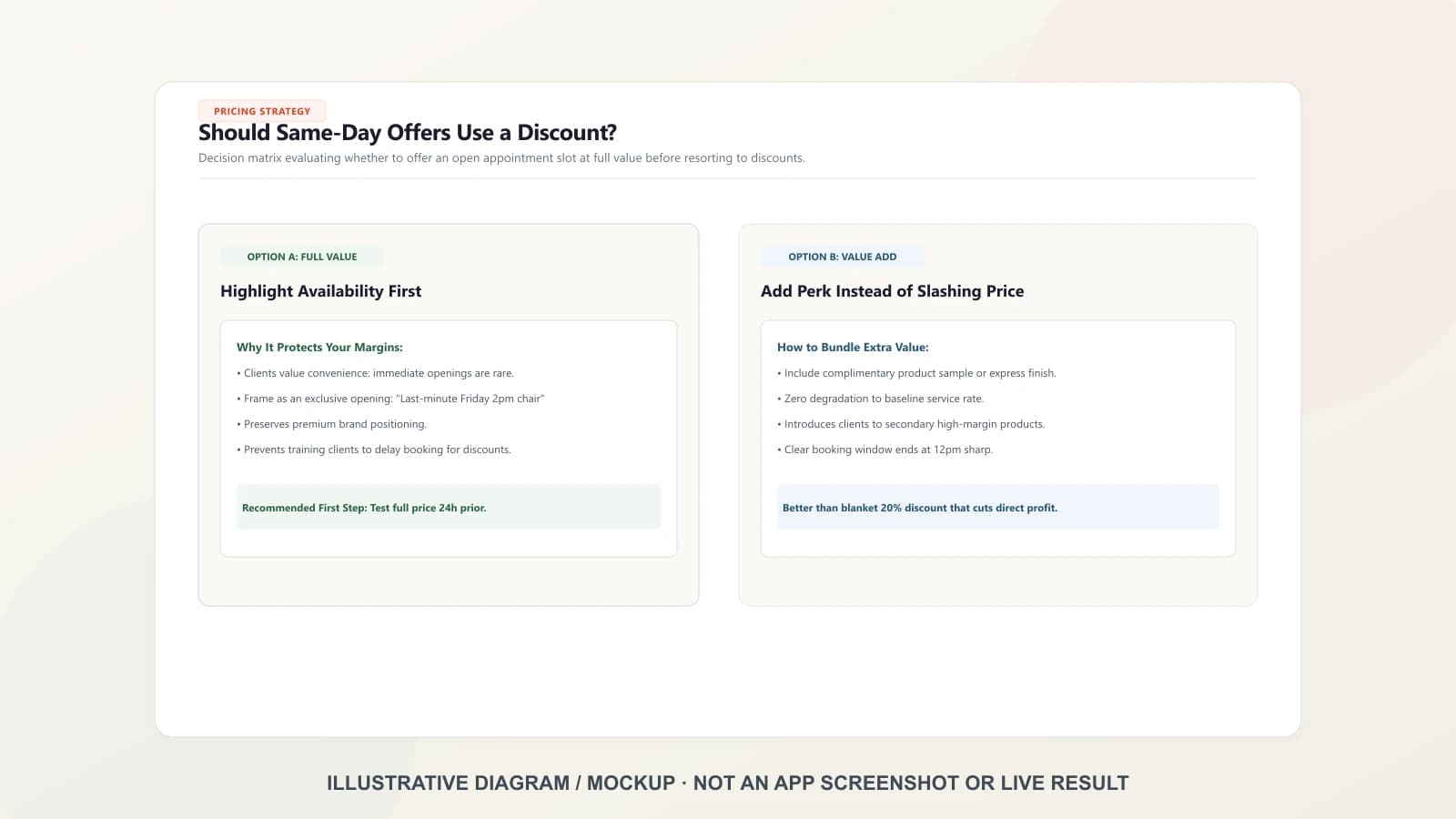
Start with a clear full-price invitation when the service or product is already valuable and the available time is the main news. Add a small, genuine extra when it helps someone decide. Use a discount only when the owner knows the economics and the terms can be stated honestly. A same-day offer does not need to be a sale.
No version can promise that a slot will fill or that stock will sell. The better test is whether the offer is true, understandable, deliverable, and worthwhile for the business.
The three choices
| Choice | When it may fit | What to check |
|---|---|---|
| Full-price invitation | Customers already want the service; they simply do not know a place opened | Is the time, place, service, and booking route clear? |
| Added value | A small relevant extra helps a customer picture the experience | Can the team deliver it to everyone who qualifies? |
| Limited discount | Inventory is perishable or an otherwise empty capacity window has a measurable cost | Does the price still make sense after labour, materials, and fees? |
Do not call a normal service “exclusive” just because an appointment is open. Do not offer a free extra that the team has not agreed to provide. And do not present a routine everyday price as a one-day reduction.
Work through one example
Imagine a local florist has six finished autumn bouquets at noon, and the shop closes at 6 pm. The flowers are fresh, but the arrangement is today's design. This is an illustrative scenario.
Option 1: full price. “Six autumn bouquets are ready to collect from our Riverside shop today until 5:30 pm, while they last. See the current collection link for details.” If customers already value the design and convenience, this may be enough.
Option 2: added value. The owner might include a handwritten gift note with each bouquet, if staff can do it and the note is relevant to customers. The post must state the exact condition: “A gift note is included with today's ready-to-collect bouquets.” It should not say “free delivery” unless delivery exists and is funded.
Option 3: discount. The owner could set a specific price reduction for collection after 4 pm. Before announcing it, they calculate the remaining margin and consider whether regular customers will start waiting for afternoon reductions. The post names the actual price or percentage, start time, shop, eligibility, and end condition. If the business cannot confirm those facts, do not publish a discount.
The options are not a ladder that every business must climb. Choose one, then make the message easy to act on. A time-limited offer is useful only if the team can keep its terms.
A two-minute decision tree
- Would customers want this at its normal price if they knew it was available now? Try the full-price invitation.
- Is there a relevant extra the team can deliver without changing the economics badly? Consider added value.
- Is remaining stock or unused capacity likely to be lost, and has the owner approved a price floor? Consider a limited discount.
- Are the terms still uncertain? Hold the offer and confirm them first.
For an appointment rather than stock, make sure the available service fits the opening and that the booking path works. The open-appointment post guide shows the finished wording. The broader last-minute opening playbook helps decide whether a public post is the right action at all.
Where Mazuly helps
Last-Minute Offers can prepare a visual and caption from the owner's confirmed time, product or service, location, and chosen terms. Brand Brain gives the AI the business voice and saved context. It cannot choose the right margin or know today's stock unless the owner supplies it. Review the final visual, on-image line, caption, hashtags, and booking or collection route before publishing.
A good same-day offer makes a real opportunity visible. It does not have to make the business cheaper.