
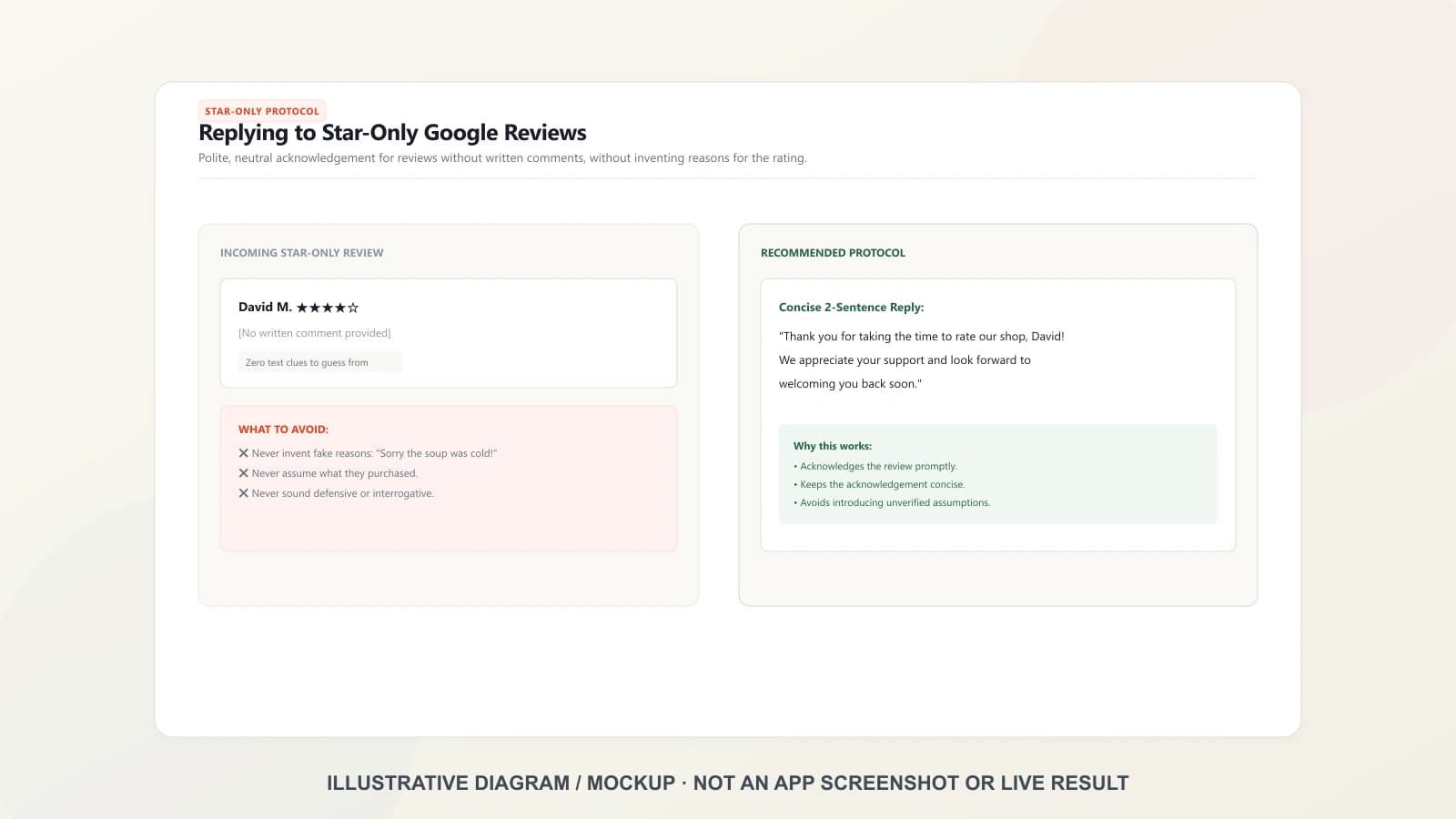
A star-only Google review tells you how someone rated the business, but not why. You can thank the reviewer or invite them to share more, but you cannot honestly say which service they used, which employee helped, or what went wrong. The safest reply is short enough to fit the evidence you have.
Google says business replies are public, should be professional and relevant, and should avoid promotional language. It also advises businesses to make replies count rather than sending the same thank-you to everyone. Google's review-reply guidance is the baseline for the examples below. These are editorial suggestions, not Google-required scripts.
First decide whether a reply helps
A five-star rating with no words may only need a brief thanks; it does not need a paragraph of invented praise. A three-star rating gives too little information to diagnose a problem. A one- or two-star rating deserves the owner's attention, but a public reply should not guess at a complaint or expose a private customer record.
If you have nothing relevant to add, it is reasonable to leave a star-only rating unanswered. Google encourages useful, genuine replies, not a quota of replies to every rating. When you do respond, write for both the reviewer and the next customer who will see the exchange.
| Rating with no written review | Cautious sample reply | Owner decision |
|---|---|---|
| 5 stars | “Thank you for the five-star rating. We appreciate you taking a moment to share it.” | A short acknowledgment may be enough. Do not claim a particular visit or result. |
| 4 stars | “Thank you for rating us. We appreciate it. If you have a suggestion for us, we would be glad to hear it.” | Invite detail gently, without treating four stars as a complaint. |
| 3 stars | “Thank you for leaving a rating. If you would like to tell us more, please use our contact page so we can listen.” | Check that the contact page works before publishing this version. Do not assume what was missing. |
| 2 stars | “We are sorry to see this rating. We would welcome a chance to understand your concern. Please contact our team through our website.” | Have a person review the response and the verified contact route. |
| 1 star | “I am sorry to see your rating. I would like to understand what happened. If you are willing, please contact me through our business contact page.” | The owner or responsible manager should handle this; do not debate a guessed incident in public. |
Replace “our contact page” with a route the business actually monitors. Do not paste these replies unchanged across a batch of reviews. With no written detail, some overlap in wording is honest; forced personalisation would be worse. A reply should not say “we loved helping with your haircut” or “sorry the meal was cold” when the reviewer supplied only a rating.
Keep low ratings on a human path
For one or two stars, check whether the business has a relevant recent issue it can responsibly investigate, but do not identify the reviewer from private records in a public reply. The rating alone may not tell you who visited or what happened. Ask for a private conversation through an existing business route and have the owner or manager decide whether follow-up is appropriate.
A low rating is not automatically a policy violation. Google's review-reporting guidance says reviews are eligible for removal only when they violate its policies; disagreement or dislike is not enough. If the reviewer later adds written context, read it before updating the reply. Google lets a verified business edit or delete its public reply, but the first version may already have been seen.
Set the automatic-reply rule deliberately
With a connected Google location, Mazuly's Google Review Replies lets an owner select which star ratings receive automatic replies. Ratings outside that selected set can wait as drafts. The setting is by star rating, not a promise that the system knows why a star-only reviewer chose that rating.
For example, an owner might allow automatic replies to four- and five-star reviews while holding one through three stars for a person. Another owner may leave every rating as a draft. Check representative replies before enabling a rule and inspect what appears publicly after it is active. A five-star review can contain critical written text even when most five-star reviews do not, so do not treat the selected rating as a sensitivity filter. The rule applies to the rating, not just to reviews with no text.
If a reply invents details, sounds repetitive, or mishandles a mixed review, narrow or turn off the selected-rating rule and review the affected replies. A sensitive complaint needs a person, even if the stars look favourable. For the wider response approach when a reviewer writes actual feedback, use how to reply without a template; for a difficult written review, see the one-star response guide.
Check the public result
On the verified business's Google Business Profile, open Read reviews and inspect the public reply beside the star rating. Read it as a customer would: does it stay within what the rating actually says, and does any contact route work? If the wording is wrong, correct the reply. Google's review management instructions explain how to read, reply and edit.
The useful rule is simple: answer only what the rating actually tells you. Thank a positive reviewer without inventing their story; invite context from a middling rating; and keep serious concerns with a person who can listen and act.