
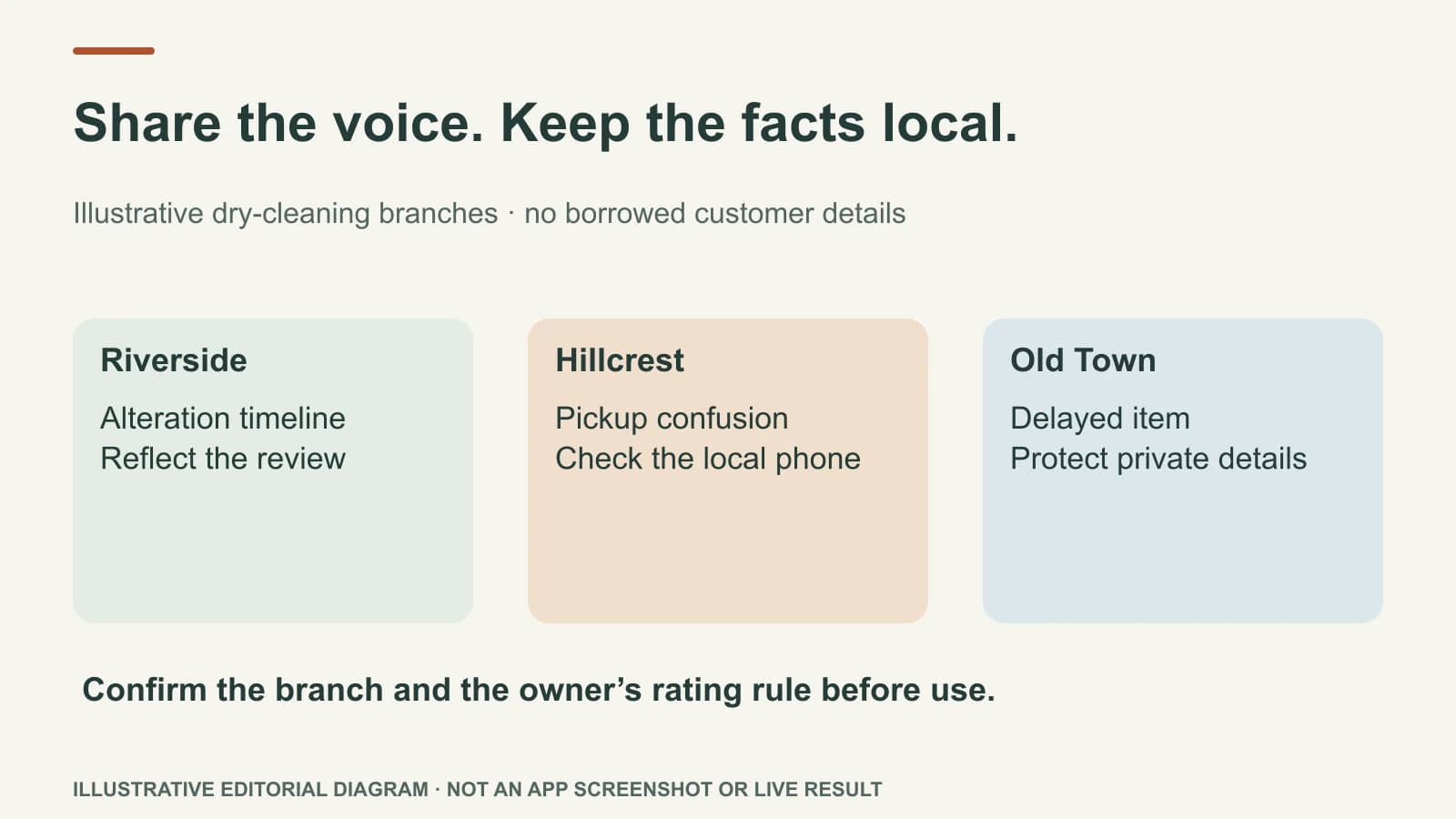
A multi-location review reply should use the shared brand voice without borrowing facts from another branch. Check the reviewed location, the service mentioned, and the owner's selected rating rule before a response is posted. A reply that thanks the customer for visiting the wrong address can erode trust even when the wording sounds polished.
If several independent brands share an owner, keep their contexts entirely separate. A common process is useful; a common customer story, service list, or tone may not be.
Three reviews, three local answers
Imagine a fictional dry-cleaning business with Riverside, Hillcrest, and Old Town branches. Its service standards are shared, but pickup hours and specialty services differ. These sample reviews are invented to show the decision process.
Riverside, five stars: “The team explained the alteration timeline clearly.” A fitting reply: “Thank you for taking the time to share this. We're glad the Riverside team made the alteration timeline clear. We appreciate you choosing us.” The reply reflects the review. It does not add a promise that all branches provide alterations on the same schedule.
Hillcrest, three stars: “Good cleaning, but I wasn't sure when pickup was ready.” A useful draft: “Thank you for the feedback. Clear pickup information matters, and we're sorry it was confusing. We'd like to check what happened at Hillcrest and improve the handoff. Please contact the branch using the number on its profile so we can follow up.” Before posting, the manager confirms that the phone route is staffed and that the business can investigate.
Old Town, one star: “My item wasn't ready when I expected.” A draft should be held for owner review if that is the chosen rule: “We're sorry the timing did not match your expectation. We'd like to look into this directly without discussing your order in public. Please contact the Old Town manager through the number on this profile.” Do not reveal the item, order record, or the customer's contact details. Do not import Hillcrest's pickup process into the Old Town reply.
These examples show why the location is not a decorative label. It determines which manager can help, which phone number works, and which operational issue needs attention.
Set rating rules deliberately
Mazuly's Google Review Replies lets the owner decide which ratings are eligible for automatic replies and which should become drafts for review. One owner may allow automatic replies to four- and five-star reviews while holding one- to three-star reviews. Another may choose to review every rating. The business should confirm its own settings rather than assume a universal rule.
Whatever the setting, check a sample of actual replies. A high rating can still contain a complaint or sensitive detail. The rating is useful routing information, but it does not make the content risk-free. For a low-rated review, the one- and two-star reply guide gives a more careful owner-review path.
Keep a local fact card for each branch
For each location, confirm its public name, services, current hours, phone route, and person responsible for escalations. Add branch-specific language only when it is supported by the review or verified business context. A generic “Thanks for visiting our Hillcrest team” is not better than a shorter reply if the review belongs to Riverside.
Brand Brain helps Mazuly's AI use saved business and location context, while multi-location marketing guidance explains how to keep other outputs local. The owner remains responsible for current branch facts and rating settings.
Review outcomes separately
Count the reviews and replies for each branch, but do not treat a faster reply as proof of a ranking or revenue change. Google says local results consider relevance, distance, and popularity; reply quality is primarily a customer-trust and service matter. Look for recurring complaints the branch can actually address.