
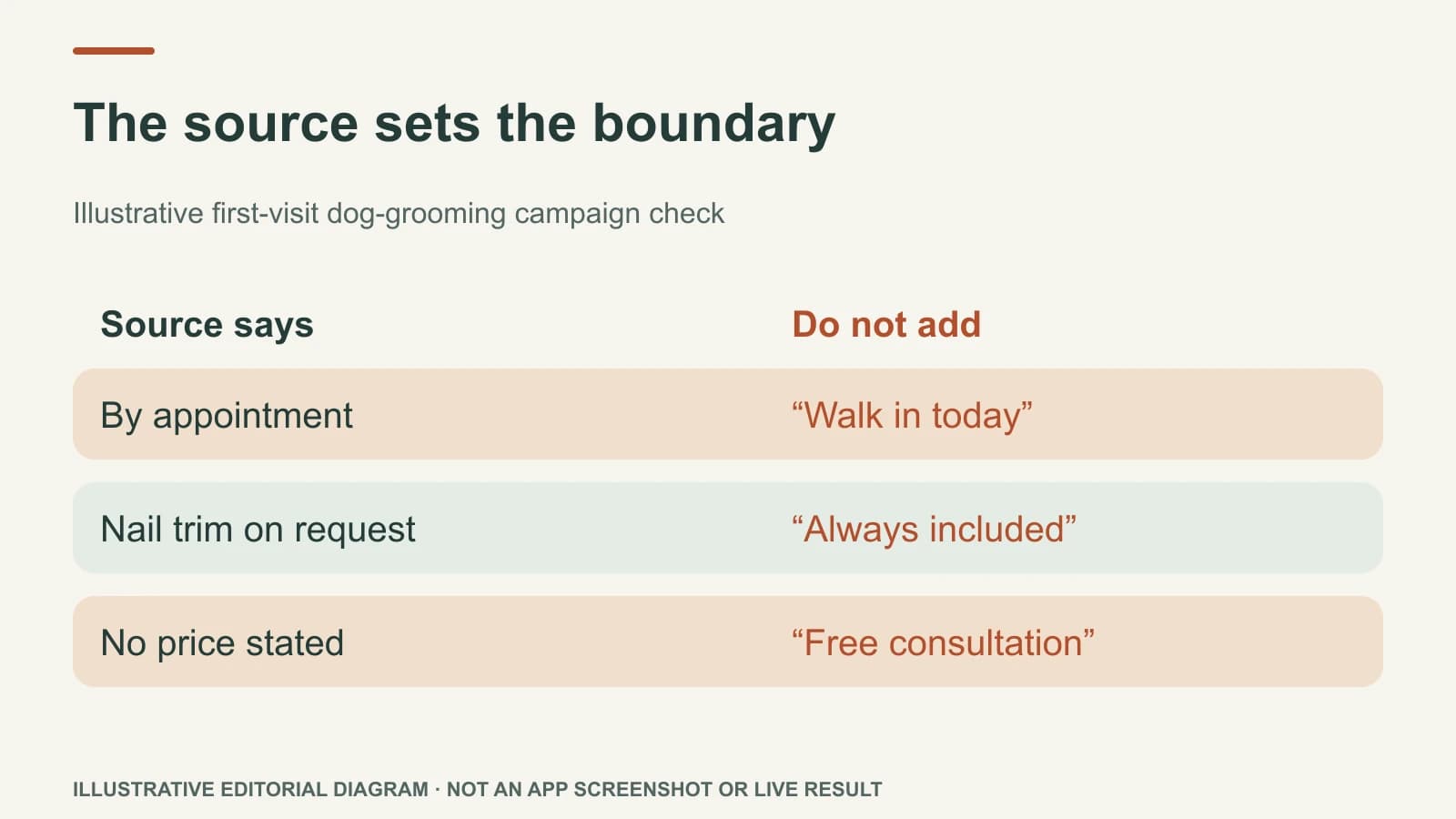
Before publishing a campaign made from a web page, compare every consequential claim in each post with the source page and today's business facts. A URL gives an AI system a place to start; it does not guarantee that the page is current or that every generated caption interpreted it correctly. The owner should be able to trace service, price, location, availability and booking wording back to a real source.
This is the quality-control step after a Campaign Studio campaign has been prepared. The existing URL-to-five-post guide covers how to turn a page into a varied campaign; here the job is to catch errors across those five finished posts.
Make a source-fact inventory first
Imagine an illustrative dog-grooming studio with a public page at https://your-business.example/services/first-visit-grooming. The .example address is a teaching placeholder, not a live service page. Assume the real page, once checked, says:
- first-visit grooming is by appointment at the Riverside studio;
- a consultation is included before the grooming work begins;
- nail trimming is available on request, not included automatically;
- the page does not state a price or promise same-day availability;
- customers should use the booking enquiry form to ask about openings.
Put those facts in a simple record before reading the posts. Mark the page's last verified date. If a fact is missing, do not ask the AI to fill it with a plausible industry norm.
Review five post angles against that record
A five-post campaign should give five reasons to pay attention, not five copies of one image and line. It still has to stay within the source.
| Post angle | Legitimate message from this source | A tempting error to catch |
|---|---|---|
| What happens first | “We begin with a consultation” | “Free expert consultation” when the page does not say free |
| What the service includes | Explain the actual first-visit grooming process | “Nail trim included” when it is request-only |
| Where to visit | Name the real Riverside studio | Add a second location from another brand |
| How to book | Invite an enquiry about appointments | “Walk in today” when booking is required |
| A real photo | Show the studio or permitted finished work | Use a stock animal as if it were a customer result |
Now examine the whole finished post: square or channel-appropriate image, on-image line, caption, hashtags if used, selected channel and next step. A correct caption does not rescue an image that says “Nail trims included.” An accurate image does not rescue a booking button that points to an unrelated page.
One before-and-after correction
Suppose a generated caption says: “Give your dog a fresh look today with our all-inclusive first-visit groom. Walk in for a free consultation.” It makes three unsupported claims: same-day availability, all-inclusive nail care, and free/walk-in consultation.
A corrected draft is: “A first visit to our Riverside grooming studio begins with a conversation about your dog's needs. Grooming is by appointment, and nail trimming can be discussed when you enquire. Use our booking form to ask about an opening.” This is less flashy and far more useful. It should still be checked against the actual current page and the owner's process.
The point is not to make every sentence cautious. It is to put confidence where the evidence exists. A true, specific detail often makes a stronger post than an invented superlative.
Check the page itself before trusting it
A source URL can be wrong. If the studio changed its first-visit process last week but the page still describes the old one, the campaign can faithfully repeat stale information. Fix the public page and the Brand Brain context first, then regenerate or edit affected posts. If the campaign is already scheduled, review the future tiles, not just the first post.
For each campaign, keep a short final record: source URL, checked date, facts used, owner who checked them, and which posts were changed. This is not a software audit trail claim; it is an editorial habit an owner or consultant can follow. It makes the next revision easier when an offer or service changes.
Decide whether the post is ready
Ask: “If a customer arrives because of this post, will the business provide what the image and caption led them to expect?” If the answer depends on a detail that the source does not state, ask the owner. Do not quietly infer a price, guarantee, service area, or availability.
That is the difference between using a URL as evidence and using it as decoration. A five-post campaign should produce variety, but every angle needs the same factual foundation.