
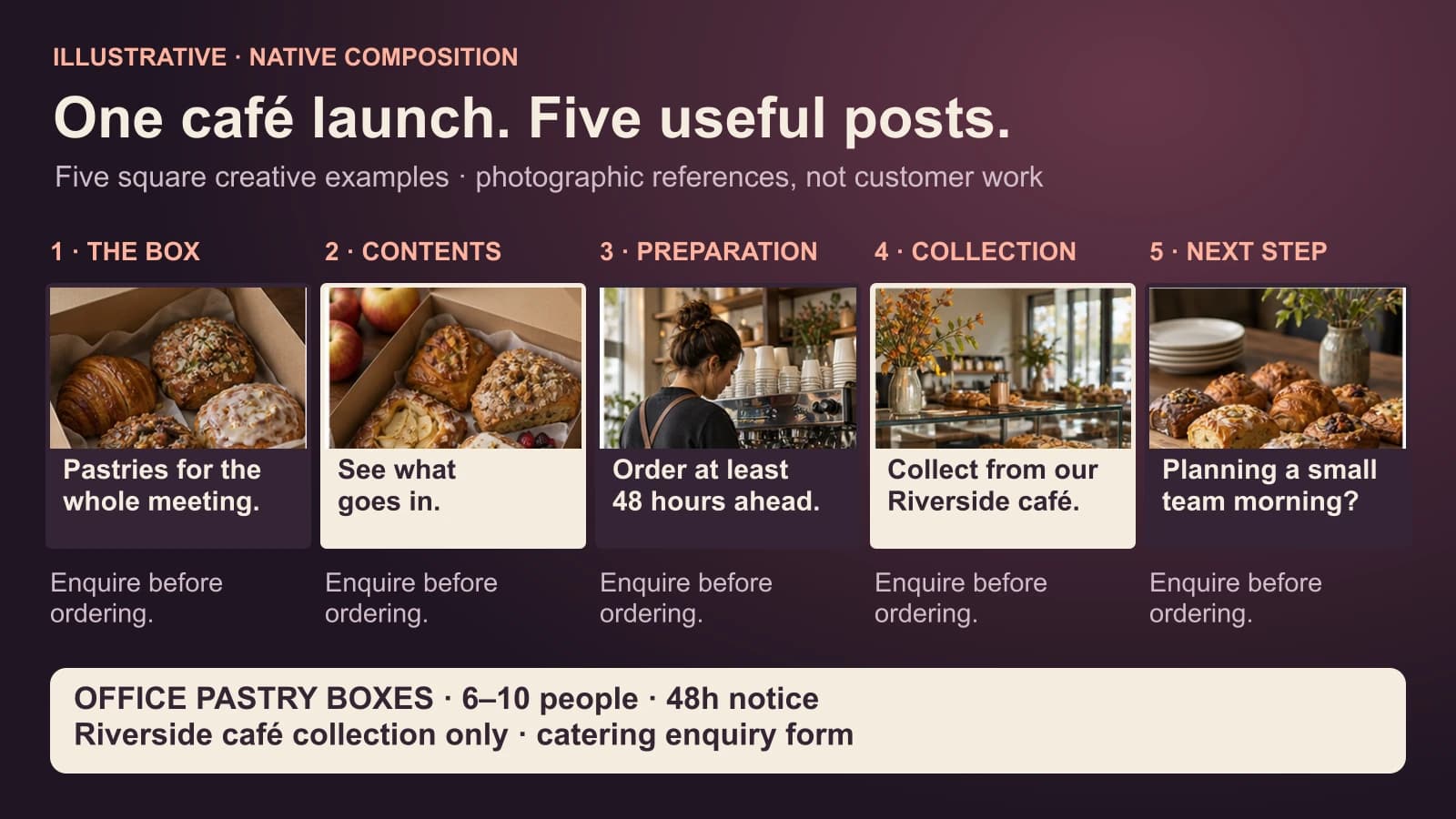
Do not announce a new service five times with the same headline. Use one verified source page to answer five different customer questions: what it is, who it helps, what is included, how it works, and how to take the next step. Give each post its own relevant real image, on-image line, caption and channel decision. That makes five pieces of useful work, not five copies of a launch poster.
The example below is an illustrative neighbourhood café launching office pastry boxes. It is not a Mazuly customer campaign or a claim that the pictured products exist. To publish this as a real campaign, the business would need the actual service page, actual product photos and current terms.
Start from a page that can support five answers
Assume the café's checked public page says: office pastry boxes serve six to ten people, need 48 hours' notice, are collected from the Riverside café, and are ordered through a catering enquiry form. There is no delivery and no price shown on the page. Those are the boundaries for every post.
Ask Campaign Studio to use the full public page URL and prepare five distinct posts. Do not ask it to guess a price or add “delivery available” because that would sound convenient. A campaign inherits the limits of its source.
The five-post sequence
1. Announce the service
Image to supply: an owner-owned photo of an actual complete pastry box. On-image line: “Pastries for the whole meeting.” Illustrative Instagram caption: “Our office pastry boxes are ready for small team mornings in Riverside. Each box serves six to ten people and is prepared for collection from the café. Give us at least 48 hours' notice through our catering enquiry form so we can confirm the order.” Tags: #RiversideCafe #OfficePastries, if those labels are accurate for the business. Next step: enquiry form.
This post answers what launched. It does not invent a price or delivery promise.
2. Show what is inside
Image to supply: a distinct, real top-down photograph of the box contents, taken when the café can verify the assortment. On-image line: “See what goes in.” Illustrative Facebook caption: “Planning breakfast for six to ten colleagues? Here is an example of how one of our pastry boxes is packed. Contents can vary; send your date and group size through the catering enquiry form and we will confirm what is available for your order.”
This post answers what to expect. If the assortment is fixed, state the real fixed contents instead of saying it varies. The image and caption must agree.
3. Remove a practical booking doubt
Image to supply: a genuine preparation or packaging photo, not the same box hero shot. On-image line: “Order at least 48 hours ahead.” Illustrative Instagram caption: “A little notice helps us prepare the pastry box for your meeting. Please send your preferred collection date and the number of people through our catering enquiry form at least 48 hours ahead. We will confirm the order details with you.”
This post answers how early to ask. The “we will confirm” wording matters: an enquiry is not a completed order.
4. Show collection clearly
Image to supply: an original photo of the café entrance or pickup counter. On-image line: “Collect from our Riverside café.” Illustrative Facebook caption: “Our office pastry boxes are collected from the Riverside café. If you are arranging a team morning, use the catering enquiry form to tell us the date and group size. We will confirm the collection details with your order.”
This post answers where it happens. It prevents someone from assuming delivery or visiting a different branch.
5. Give the undecided customer a simple next step
Image to supply: a fresh photo showing the box at a real table, with permission from anyone shown. On-image line: “Planning a small team morning?” Illustrative Instagram caption: “If a six-to-ten-person pastry box would make your next meeting easier, tell us when it is and how many people are coming. We ask for at least 48 hours' notice and prepare confirmed orders for collection in Riverside. The catering enquiry form is the place to start.”
This post answers what should I do now? It is not a fifth “we launched” announcement. Publish it only if the service is still available and the image is current.
Spread the angles, then check the whole set
The owner might use posts 1 and 2 in launch week, post 3 when customers commonly plan meetings, and posts 4 and 5 later. There is no universal optimal cadence; check the café's actual calendar and avoid placing two nearly identical offers on one day. Social Planner can display the selected image, post name, channel and planned time for each tile.
Before approving the set, read across all five images and captions. Is the same product shown honestly? Are the group size, notice period, collection location and enquiry route consistent? Does each post give the customer a new reason to care? The source-page campaign check gives a claim-by-claim review method.
The service-page-to-social guide explains the general method. Use this five-angle sequence when a new service really supplies enough facts and original images; if it does not, publish fewer, stronger posts rather than repeating the launch line.