
An AI Brand Brain is a saved, editable picture of the business behind a request: what it offers, where it works, how it sounds, which photos and facts it can use, and what it must not invent. When you ask Mazuly for marketing work, relevant Brand Brain details go into that AI request. That makes the starting point your business, rather than a blank chat window. It does not make a wrong fact true or remove the need to update something that changed yesterday.
Think of it as the brief you would give a capable new colleague. “Write a post” is vague. “We alter everyday clothing by appointment; standard alteration turnaround is usually two weeks; use a practical, warm voice; don't promise same-day alterations” gives them a chance to make something useful.
Save facts that change the answer
The most valuable context is specific enough to alter an output. A generic adjective such as premium is less useful than a real service, location, or restriction.
| Context to save | What it changes in the work | Question to ask before saving it |
|---|---|---|
| Services and products | Which offer or appointment the post describes | Is this still available? |
| Location and service area | Whether the wording fits a local customer | Does this apply to this exact branch? |
| Real photos and visual direction | Which business the creative looks like | Do we have permission to use this image? |
| Business voice | Whether a caption sounds direct, warm, formal, or playful | Would the owner say this to a customer? |
| Important limits | Claims, words, prices, or promises the AI should avoid | Is the limit clear enough to check? |
| Current priorities | Which real moment matters this week | When does this priority expire? |
Not every detail belongs in every output. A review reply needs the location's service facts and tone, but it does not need a month of campaign ideas. A social plan may need upcoming events, usable photos, and opening hours. Saving context lets Mazuly select the relevant facts for the work instead of making you restate them in every request.
A worked example: one business, two different outputs
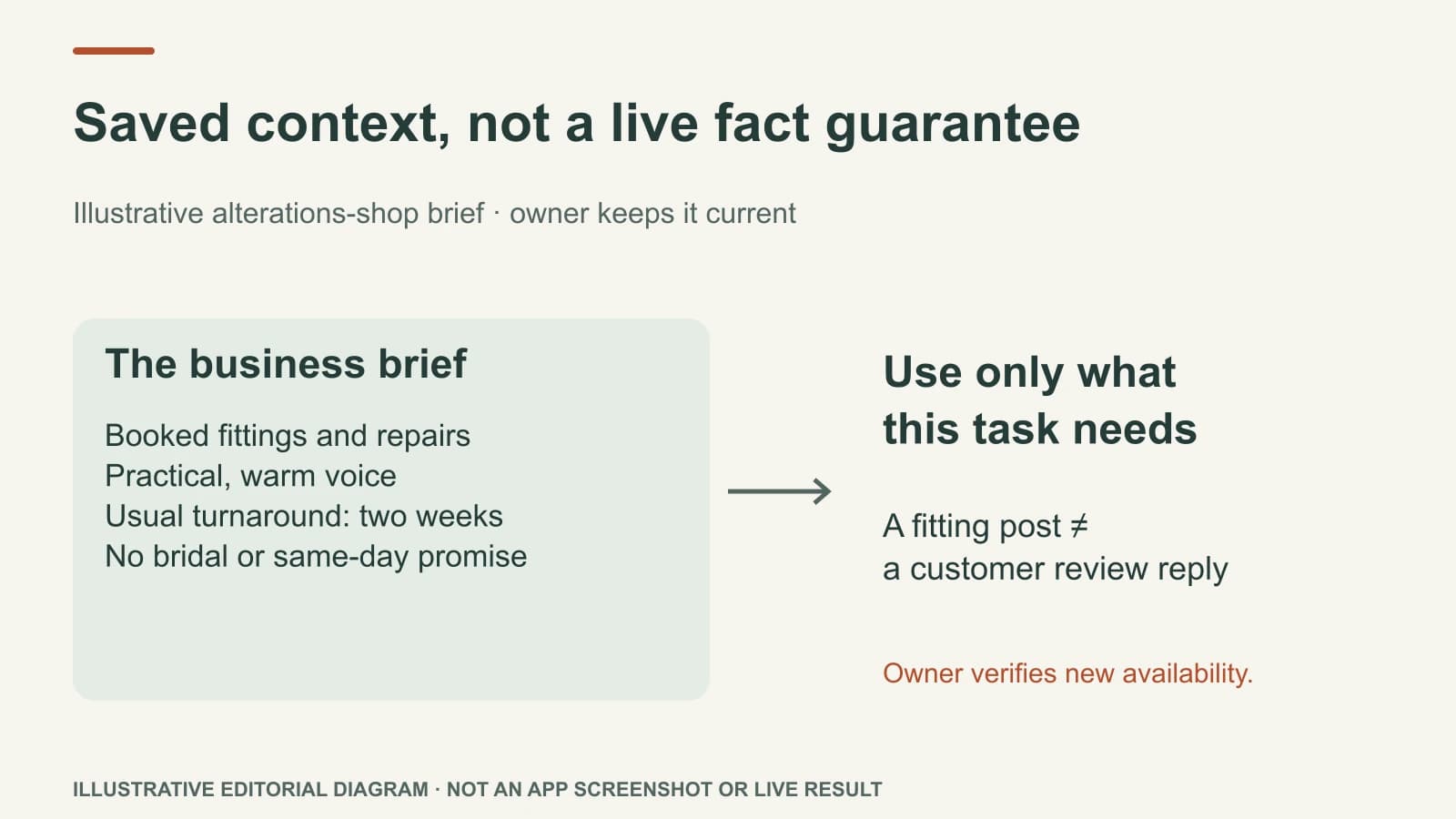
Illustrative business: an independent alterations shop offers booked fittings and standard clothing repairs. Its voice is practical and warm. It does not offer bridal alterations, and its usual turnaround is two weeks; the owner does not promise same-day work.
Without context, “Write a post about Saturday availability” could produce: “Bring any outfit today for an instant transformation. Walk in anytime for same-day bridal alterations.” The sentence is energetic, but the walk-in, turnaround and bridal claims are unsupported.
With those saved facts and the owner's new instruction—“We have two Saturday fitting appointments open”—a more useful draft is: “Two Saturday fitting appointments have opened at our alterations shop. Bring the garment you would like us to assess and ask about the available times. We will explain the work and current turnaround before you book.” The owner still has to supply the actual times and confirm that the appointments remain open. Brand Brain helped remove the invented walk-in, bridal and same-day promises; it did not create live availability.
The same business could ask for a reply to a customer review saying, “The hem was neat and the staff explained the fit.” A grounded draft might say: “Thank you for taking the time to tell us. We are glad the fit explanation helped, and it was a pleasure working on your garment.” The owner checks the review and chooses whether to use that reply. It does not insert the Saturday offer or the two-week lead time. Business context should guide the answer, not leak every saved detail into it.
How Mazuly gets and uses the context
Mazuly can start with a business website to gather services, location, imagery, and a sense of its voice. The owner can add or change the details that matter. When Ask Mazuly prepares a post, plan, offer, or reply, it passes relevant saved context alongside the new request to its AI. That is the distinction between Brand Brain and simply typing the business name into a general chatbot each time.
There are two separate steps:
- Learn and maintain the business. Check services, locations, photos, voice, and limits against what is true now.
- Use that context in an output. Give Mazuly the new moment: a photo, public service URL, opening, review, or monthly priority. Read the resulting work for current facts and customer clarity.
For a new campaign, an owner might paste a service-page URL into Ask Mazuly and request five different posts. The URL supplies the current service information; Brand Brain supplies the broader business context. The five posts still need their own useful angle, finished creative, caption, and next step. Merely repeating the same slogan five times would not be a campaign.
Where a Brand Brain can go wrong
Saved information can become stale. If a location changes hours or stops a service, a polished draft can still be wrong. Make updating the relevant facts part of the change itself: edit the business information, then ask Mazuly for the new post or plan. A website scan is a starting point, not a promise that the site was accurate.
Context can also be too broad. If one company has two brands or locations, keep their local details separate. The customer in one town should not see the other town's address, staff, offer, or hours. If a claim needs proof—“the fastest,” “guaranteed,” or a regulated benefit—do not turn it into a saved brand slogan just because an old brochure used it.
Finally, a Brand Brain is not a search ranking switch. It can help Mazuly choose the correct business and service when preparing work or checking visibility. It cannot force Google Maps or an AI answer to show that business. Search Visibility and AI Visibility report observations from their respective checks; they answer different questions.
A ten-minute first setup
Write down your three most important current services, the exact location or service area each applies to, one sentence that sounds like you, two claims you would never make, and one real photograph you can use. Then try one ordinary request: “Use this photo to tell customers what we finished today.” Check whether the output preserves the real service and location, and correct the context if it does not.
The aim is not a perfect brand document. It is a reliable starting point that makes the next useful piece of work more recognisably yours. If you want a broader comparison with general chat tools, read when saved business context matters.