
Give the AI your specific services, place, customers, everyday language, and limits. Then edit the result against a real example of how you speak. A list of adjectives such as “friendly, premium, authentic” is rarely enough. A good AI-written post sounds like your business because it names something true that another business could not honestly say.
Mazuly's Brand Brain stores that context so relevant details can accompany a new request. It is a starting brief, not a guarantee that every generated sentence is accurate. The owner still needs to catch stale offers, invented claims and words that feel wrong.
Run the same request with and without a real brief
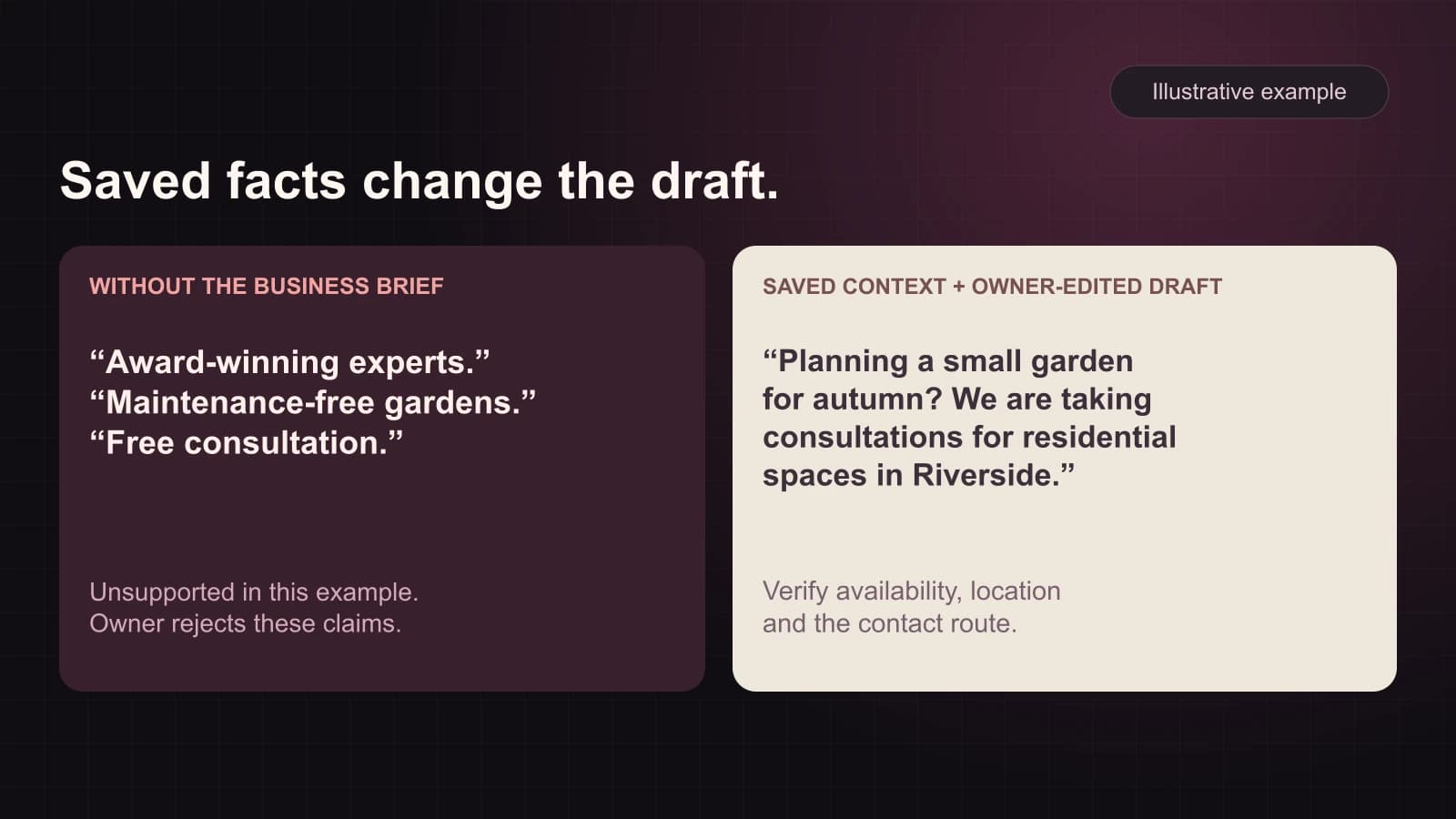
Consider an illustrative garden design business. It plans compact residential gardens in Riverside, uses native plants when appropriate, and prefers practical language. It does not promise a maintenance-free garden, and it does not claim every project increases a home's value.
The owner's request is: “Announce that we're taking consultations for autumn garden plans.”
Without the business context, an AI might write:
Transform your outdoor oasis with our award-winning experts! Our breathtaking, maintenance-free gardens will boost your property value. Book your free consultation today!
That copy has energy, but nearly every meaningful claim is unsupported. The business did not say its work is award-winning, maintenance-free, value-boosting or free to consult. A polished sentence is not a usable post.
With the saved facts, a better draft would be:
Planning a small garden for autumn? We are taking consultations for residential spaces in Riverside. Tell us how you use your space and what you would like to change; we can discuss a planting and layout plan that fits it.
The second version is more modest and more useful. Before using it, the owner must still verify that consultations are open, the location is correct, and the contact route works. If consultations have a fee, state that where it affects a customer's decision.
The difference is not a magic “brand voice” filter. It is the presence of facts and boundaries that change what the AI is allowed to say.
A five-point voice and truth test
Read the draft aloud and score each question yes, no, or needs checking:
- Could another local business say this unchanged? If yes, replace a generic boast with a real service, customer situation, or process detail.
- Would the owner say these words to a customer? Swap “unlock your outdoor potential” for the phrase the team actually uses when discussing a garden.
- Does every claim have a source? A price, guarantee, service area, award or turnaround time needs current evidence.
- Is the customer's next step clear? Say whether to book, enquire, visit, call or read the service page. Do not assume the platform will supply a useful button.
- Does the visual match the sentence? A real client's small courtyard should not sit under a caption promising a full property redesign.
This test catches both weak writing and risky marketing. It also gives a specific correction to send back: “We do not call it a free consultation,” or “The photo is from a planting job, not a design consultation.” “Make it more on-brand” gives an assistant much less to work with.
Save examples, not just adjectives
Choose two short pieces of existing language the business would happily send again: an appointment confirmation, a good customer reply, a service-page paragraph, or a founder's explanation of the work. Identify what makes them sound right. Maybe sentences are short. Maybe the business names materials rather than using decorative adjectives. Maybe it avoids exclamation marks. Save those preferences with the relevant business facts.
Also save negative rules. “Never say guaranteed same-day installation” is more useful than “be trustworthy.” If a claim requires a licensed professional, owner sign-off, or a current price list, state that requirement. For several locations, check that the example voice and local facts belong to the correct location.
Brand Brain can pass relevant context to Mazuly's AI when it prepares a post, reply, plan or offer. It does not mean every saved fact should appear in every caption. A helpful review reply should answer the review, not append the entire brand story.
What belongs on the image and what belongs in the caption
For a social post, the on-image line can be short: “Autumn garden plans start here.” The caption can explain the real service and enquiry route. Hashtags, if used, should describe the actual place and subject; a branded hashtag cannot repair an inaccurate offer. Preview the finished creative at phone size so the words are legible and the image still shows the real work.
One source photo can support different words for different moments, but do not publish five posts that merely replace the first line while the image and customer value stay identical. If the business is using Photo Studio, keep the source and finished visual recognisably truthful. If it is using Campaign Studio, give each post a different useful angle grounded in the source page.
If your general AI drafts keep missing the mark
The ChatGPT and saved-context comparison explains why a general chat starts without these saved facts. For the next draft, correct the specific missing service, location, phrase or restriction, then run the five-point test again. A business-like voice is built from accurate choices, not from asking an AI to “sound less like AI.”