
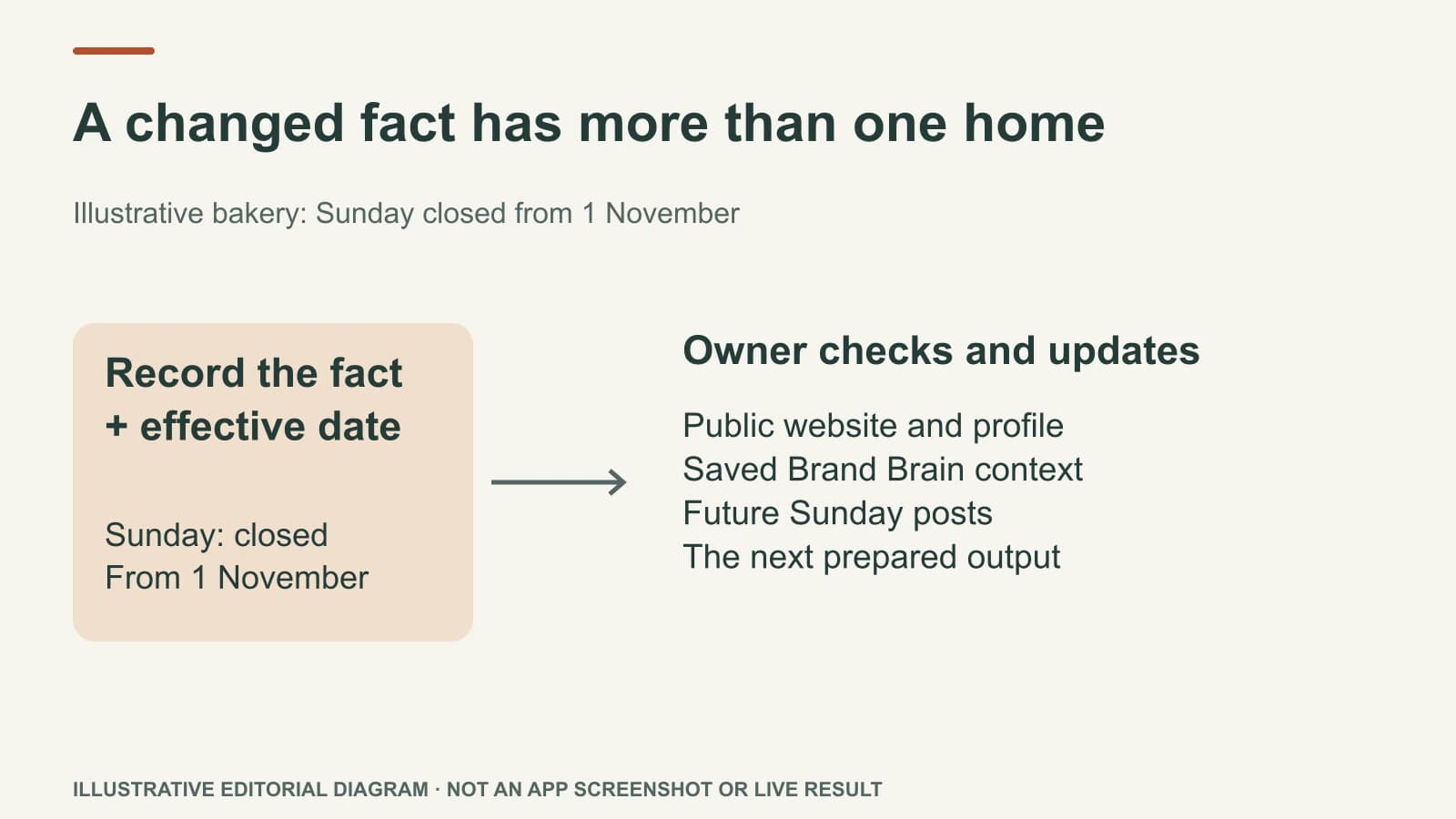
When a service, hour, price, location or offer changes, update the source fact first, then check any marketing work that depends on it. That includes the website, relevant profile information, saved Brand Brain context and posts already planned for the future. An AI assistant cannot reliably infer today's business change from a website that still says yesterday's hours.
This is not a complicated content-governance program. It is one habit: before asking Mazuly to prepare the next post, make sure the business truth it will use is current.
A concrete example: Sunday hours change
Imagine a neighbourhood bakery that decides to close on Sundays from 1 November. Its website still says it opens at 8 a.m. on Sunday. A social calendar already contains a 15 November post saying “Drop in this Sunday for fresh bread.” Brand Brain was set up when the older hours were correct.
The problem is bigger than one outdated web paragraph. If a new caption uses saved or public business details without the change, it can sound entirely convincing while sending someone to a closed shop.
Use this order:
- Record the new fact and effective date. “Sunday closed from 1 November” is unambiguous. “Hours changing soon” is not.
- Update the public places customers rely on. Correct the bakery's website, contact/booking route and Google Business Profile as applicable. Google asks businesses to keep hours and other profile information complete and accurate. Its local ranking guidance explains why accurate details matter to customers and local search.
- Update the saved business context. Make the relevant change in Brand Brain so later Mazuly requests start from the new hours.
- Review future work. Find planned posts, offers and campaigns that mention Sundays, opening, pickup or visits. Change or remove them before their scheduled date.
- Check the new output. Ask for a fresh post only after the fact is fixed. Read it for the correct effective date and customer action.
If the bakery changes back in December, repeat the sequence. Do not rely on an old generated caption to update itself.
Keep a tiny change log
An owner does not need an enterprise database to avoid contradictions. A short log can make the change visible to whoever edits the site or approves content.
| Fact | Old value | New value and effective date | Places to check | Owner |
|---|---|---|---|---|
| Sunday opening | 8 a.m.–2 p.m. | Closed from 1 November | Website, Google profile, Brand Brain, November calendar, pickup offer | Bakery owner |
| Catering cutoff | Two days before | Three days before from 10 November | Catering page, email reply, campaign captions | Catering lead |
Those rows are illustrative. A real business should record only the systems it actually uses and the person who can verify the fact. The column that matters most is places to check: it prevents a page from being updated while the social plan keeps repeating the old information.
Know which changes need a wider review
Some facts are local to one post. A sold-out pastry needs that day's offer changed. Other facts spread across the whole business. A changed address, discontinued service, or altered booking policy may affect the homepage, service page, profile, scheduled posts, review replies, and image captions.
For multiple locations or brands, record which location changed. One branch may close on Sundays while another stays open. Keep each location's Brand Brain and calendar context distinct. The multi-location guide deals with the broader separation; this article focuses on what to do on the day a fact changes.
If an old photo shows a product no longer sold, the photo itself may remain an honest image of past work, but a new post must not imply the product is currently available. If a scheduled campaign was built from a service URL, check whether the source page has changed since the campaign was prepared. A campaign can be internally consistent and still be obsolete.
Ask Mazuly for the new work after the update
Once the source facts are corrected, a useful request is: “From 1 November we are closed on Sundays. Please revise the November bakery plan so no post invites Sunday visits, and draft a short hours update for our customers.” This gives the assistant the actual change, date, and job. Review the resulting plan tile by tile. The owner may have to decide whether a Sunday-themed post becomes a Saturday pickup post, an advance-order reminder, or no post at all.
Mazuly's context helps the AI prepare new material that fits the business. It does not automatically certify every fact in a public website or third-party profile. Review the work for contradictions before publishing from Mazuly, especially when timing, stock or eligibility matters.
If an old error has already spread
Use the outdated business information guide to find stale facts customers may already see. Then trace each correction through saved context and planned posts. Fixing the website alone is not enough if a campaign is ready to repeat the old fact next week.